American Indian Law: a Surge of Interest on Campuses
By KATHERINE MANGAN
Tempe, Az.
Growing up on a Navajo reservation near Gallup, N.M., Jordan Hale never dreamed he would one day be standing in front of a courtroom recommending whether a defendant should be released on bond, or working with a prosecutor to draft a criminal complaint.
Becoming a lawyer was the farthest thing from the mind of the high-school runner whose home, at the end of a dirt road, had no running water or telephone.
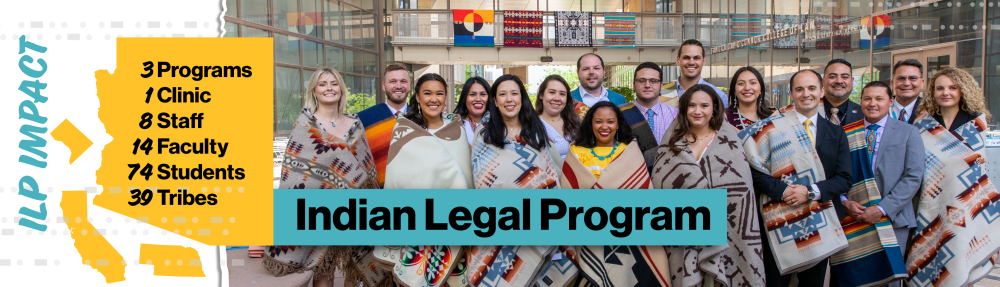
Now he is one of 37 students, representing 29 Indian tribes, who are specializing in Indian law at Arizona State University’s Sandra Day O’Connor College of Law. All but one of the students are American Indian, and they bring with them diverse traditions of such tribes as the Chippewa, Choctaw, Crow, Jicarilla Apache, and Mohawk.
At law schools nationwide, interest in Indian law is growing as the economic clout and political influence of the nation’s 562 federally recognized tribes have expanded.
Arizona State’s Indian Legal Program allows students who are pursuing their J.D.’s to simultaneously earn certificates in Indian law. They study the differences between the legal systems of tribes and that of the U.S. government, and many go on to represent the interests of tribes, Indian clients, or the federal government.
Tribes have sovereignty rights that are spelled out in treaties with the United States, so their laws don’t always align with the government’s. That is why, for instance, Indian tribes can open casinos that would not be permitted on nontribal land.
“More and more law schools are recognizing the importance of including Indian law in the curriculum because their graduates are encountering questions that require some knowledge of Indian law and sovereignty,” says Wenona T. Singel, an assistant professor of law at Michigan State University. Like many Indian law professors, Ms. Singel brings practical experience to the classroom. In addition to helping lead her law school’s Indian-law program, she serves as chief justice of her tribe, the Little Traverse Bay Bands of Odawa Indians.
She says about 20 law schools nationwide report having Indian-law programs, while other experts say the number of full-fledged programs is about 12. Among the other law schools active in Indian law are those at Harvard University, Lewis and Clark College, and the Universities of Colorado, New Mexico, Washington, and Wisconsin.
Learning the basics of tribal law is more than an academic exercise for many law students.
A few states, including New Mexico, South Dakota, and Washington, have Indian-law topics on their bar exam that students must pass to practice law. Others, including Arizona, Idaho, Minnesota, Montana, and Oklahoma, are considering adding such a requirement. Students get hands-on training in legal clinics and clerkships like the one Mr. Hale pursued over the summer at the Gila River Indian Community, 17 miles south of Phoenix.
Nationally, Indian tribes take in billions of dollars in casino revenues, which have allowed some to build state-of-the art courthouses like Gila River’s.
Mr. Hale, who is entering his third year of law school at Arizona State, worked in Gila River’s criminal-law division under the supervision of April E. Olson, a 2006 graduate of the university’s Indian legal program. Ms. Olson, who is of Mexican Yaqui ancestry, is a prosecutor at Gila River.
The tribe’s modern, high-tech courthouse stands out amid a flat landscape of desert scrub. A few blocks away, the prosecution office where Mr. Hale and Ms. Olson prepare their cases is a shotgun mobile unit located behind fences topped with coils of barbed wire.
The casinos that have helped pay for courthouse upgrades have also spurred economic development, with shopping malls, restaurants, and service industries springing up on or near many reservations. As a result, “More big law firms are looking for people who are knowledgeable about Indian law,” said Kathlene M. Rosier, director of Arizona State’s program.
Such expertise is particularly valued in a state where more than a quarter of the land is owned by one of 22 Indian tribes.
Many of the legal questions that arise involve jurisdictional disputes between the tribal and federal or state governments. For instance, what happens when an outsider commits a crime on tribal land, or a company tries to repossess a car parked on a reservation? Legal standards may also differ: Environmental regulations may be stricter on tribal lands, and child-welfare laws more relaxed to accommodate traditions of caring for children in extended families. Indian reservations, many of which are located on arid lands, have battled with the federal government over water access, with dueling parties claiming the rights to the same water sources.
Such issues are tackled in classes at the University of New Mexico’s Indian Law Program, one of the oldest and largest in the country. The program includes required courses, like those in Indian law and federal jurisdiction, and electives like Indian gaming, Indian water law, and state-tribal relations.
Because of the shortage of American Indian lawyers, graduates specializing in the field often land high-level positions. Shortly after completing Arizona State’s program, Claudette C. White became, at age 35, the youngest chief judge ever on the Fort Yuma-Quechan Reservation, where she grew up, near the intersection of Arizona, California, and Mexico.
Even after she graduated and became the tribe’s top legal authority, in 2006, she found herself turning to her professors for advice. One of them, Kevin Gover, is a former assistant secretary for Indian affairs at the U.S. Department of the Interior. (He has since become director of the Smithsonian Institution’s National Museum of the American Indian).
“Sometimes I had to adjourn court to affirm that I was heading in the right direction,” Ms. White said. Mr. Gover wouldn’t just tell her the answers. Instead he would remind her about class discussions and readings and help her work through the solution.
Although she was fresh out of law school, Ms. White was no stranger to tribal governance.
She majored in criminal justice at Northern Arizona University before returning to the reservation. She plunged into tribal politics, becoming a court advocate and working as acting general manager of the tribe’s casino.
When she was named chief judge, shortly after graduating from law school, “Some people had doubts about whether I was ready because I was so young,” she said. “But I had had a lot of personal experiences directly relevant to the cases I’m working on.” A single mother who was raising her own child in addition to the two foster children she had taken on when her own mother died, Ms. White was sensitive to child-welfare issues that came before her in court. Her struggles with her own parents’ divorce and her father’s alcohol and drug addictions gave her insight into other cases that were all too common in her courtroom.
Despite aggressive recruiting by law schools, the number of American Indian lawyers remains tiny. Nationally, the number of American Indian and Alaskan Natives enrolled in J.D. programs has grown 19 percent over the last five years, to 1,216, according to the American Bar Association. Still, that is less than 1 percent of the 141,719 students who were enrolled in J.D. programs in the 2007-8 academic year.
The 1,216 enrollment estimate may be too high, according to Heather Dawn Thompson, president of the National Native American Bar Association and a member of the Cheyenne River Sioux. Most law schools report enrollments based on the number of students who simply checked a “Native American” box. “A lot of students figure, ‘I was born in America – I’m a native’ and they figure that checking it will improve their chances of getting in, she says.
Because of the dearth of American Indian lawyers, cases involving Indians are usually handled by lawyers who are unfamiliar with tribal laws.
Nathan St. Goddard, a student at the University of Montana School of Law who worked with Mr. Hale over the summer at the Gila River reservation, believes it is important to have Indian lawyers representing the needs of Indian people. While other lawyers may come with the best intentions, they won’t have the same cultural sensitivity, he says.
“People come with some idealized notion of wanting to help the Indians and save the buffalos, but they don’t know what they’re doing,” says Mr. St. Goddard, a member of the Blackfeet tribe.
“What I see happening all the time is a non-Indian who has this romantic view of the ‘noble savage’ who thinks that we sit in our teepees and bang on our drums and pray to Mother Earth and cry every time we see a piece of trash on the ground.” What he sees when he returns home is a poor, dirty reservation of 1.5 million acres patrolled by a little more than a dozen tribal police officers. The tribal court, as well as the jail, is swamped. With his legal training and understanding of tribal life, he hopes to help change that, and would like to see other Indian students follow in his footsteps.
“Indians,” he says, “need to start saving themselves.”