Gover Bids Farewell to Law School

Gover bids farewell to law school:`This is what I’m supposed to do’

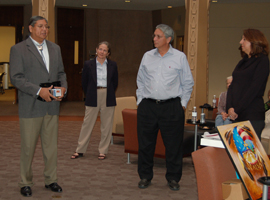
Among the guests at Kevin Gover’s farewellparty were, from left, Jacob Moore, of ASU’sOffice of Public Affairs, Patricia White, deanof the College of Law, Gover, and SandraFerniza, also of the Office of Public Affairs.

Colleagues, students and friends of Kevin Gover, a professor of the Sandra Day O’Connor College of Law and co-executive director of the American Indian Policy Institute at Arizona State University, honored him with symbolic gifts and fond congratulations during a farewell party on Nov. 26.

Gover, a former Assistant Secretary of the Interior for Indian Affairs, is returning to Washington, D.C., to accept an appointment as director of the Smithsonian’s National Museum of the American Indian, effective Dec. 2.

Gover, who will remain a professor at the law school on leave for the duration of his time at the museum, will be welcomed back with open arms whenever he chooses, said Patricia White, dean of the College of Law.

“I want to say how excited we are for Kevin and how proud we are of Kevin and, more importantly, how sad we are for ourselves that Kevin will be leaving,” White said. “Kevin’s presence here has been a wondrous thing for all of us. He has contributed to this school in innumerable ways, as a fabulous teacher and a wonderful mentor to lots and lots of students, and he has been particularly important to the students in the Indian Legal Program.”

One of them, Joe Sarcinella, a second-year law student, presented Gover with an acrylic painting from the Native American Law Student Association, which was made by Phoenix artist Joseph Wolveskill. “You are very important to us,” Sarcinella told Gover. “We’re very happy to have had the chance to study with you.”

Gover, who practiced law in Washington, D.C., and Albuquerque before serving as Assistant Secretary of the Interior for Indian Affairs, joined the College of Law in 2003.

“We didn’t come here with any thought in mind that this was a way station, or that we were just passing through, but rather with the expectation and hope that this would be a place where we would do something completely different, something that seemed worthwhile, important and noteworthy,” said Gover, who also is an affiliate professor in the American Indian Studies Program at ASU. “My hopes and my expectations were not only fulfilled, they were exceeded.

“It means a great deal to be accepted here, into such an elite, intellectual, remarkable family.” Complimenting his colleagues in the renowned Indian Legal Program, Gover said he was certain the program would continue to blossom, and he praised the American Indian Policy Institute as one of the most important such enterprises in the country.

Pat Mariella, the institute’s director, presented Gover with a plaque and thanked him for his leadership, while Eddie Brown, the institute’s co-executive director with Gover, gave him an ASU polo shirt to remind him of his academic roots.

“It’s been a real pleasure,” Brown said. “Kevin because the mastermind of many of the ideas that we developed over the last few years.”

Jacob Moore, tribal relations coordinator for the ASU Office of Public Affairs, gave Gover a Tohono O’odham basket, then joked, “We know he’ll have lots of artwork around him, so this is something to remember us by.”

Gover said his desire to continue helping Native people tell their stories led, in part, to his decision to accept the appointment to the Smithsonian.

“This museum is a place where we can really reshape Americans’ understanding of who Indians are, of who they were and who they’re going to be,” said Gover, who grew up in Oklahoma and is a member of the Pawnee Tribe. “And that’s heady stuff, that’s a big deal to me because there’s so much misunderstanding.”

He also said the new job “seemed like what I’m supposed to do now. I’m very hopeful that it won’t be too long that it seems I’m supposed to come back. I really do like it here, in no small part because of our students.

“I look forward to when I’m in my rocking chair, and I say, `Oh, yeah, that was my student.’ I know the contributions these students will make,” he said.

Article about ILP

November 16, 2007
Law Firms and Legal Affairs November 2007
Laws across nations
ASU’s Indian Legal Program trains lawyers to practice on and off the reservation
By Debra Utacia Krol, Arizona Capitol Times correspondent

Myriad laws govern the intersection of American Indian tribes with the rest of the nation.
Among other issues, Indian law touches on land, water and environment, business and family. Gaming has become a hot topic, and many attorneys’ billable hours involve gaming ordinances and policies.

As tribal governments grow ever more sophisticated, experts on understanding the interaction of tribes with other governmental entities is paramount. More and more tribes and tribal members are doing business with non-Indian firms, making commercial codes, dispute resolution and contract law a must with Indian law attorneys.

Attorneys whose practice takes them into dealings with both tribal governments and individual Indians must have a firm grasp on not just federal, state and local laws, but on tribal ordinances. But where can attorneys and law students acquire the expertise necessary to navigate the maze of tribal, state and federal laws? They turn to schools like Arizona State University’s Indian Legal Program, headquartered at the Sandra Day O’Connor School of Law.

The program was established in 1988 to train attorneys in Indian law, assisting them in understanding how tribal laws differ from federal and state law – and how they resemble each other’s systems. Its mission includes providing legal education and public service to tribal governments, and helping support tribes in policy development. As one of the nation’s largest, the program provides its students with both a firm foundation in Indian law and a wealth of practical work experience.

“As people learn more about tribes and with all the economic development growth in Indian Country, the field of Indian law grows,” says Kathlene Rosier, the program’s director. “It’s exciting to see it grow. We see more and more people coming to do business on reservations, and it’s important to know how legal systems interact.” Rosier, a Comanche whose last position was tribal prosecutor for the Gila River Indian Community, oversees the program, which trains 10 to 15 native law students from the United States, Canada and Mexico and a number of non-Indians who sign up for the program’s Indian law certificate each year.

The school also holds a number of conferences, such as one in 2008 on the effects of 20 years under the Indian Gaming Regulatory Act, which in 1988 paved the way for tribal casinos in Arizona and other states.

Students in the program can develop their tribal law portfolios in several ways. In addition to ASU’s law degree, students can earn an Indian Law Certificate. The master of law, or L.L.M., degree in tribal law and government provides those who already have a juris doctorate (JD) or equivalent with an opportunity to increase their skills and knowledge specifically in the area of Indian law. For those who do not wish to practice law, but have a need or interest in tribal law, the master of legal studies or M.L.S. program provides students with the basics of law while allowing them to choose from elective classes to gain the tribal law knowledge they desire.

Attracting top talent
The school has also attracted some stellar academic talent. Professor Paul Bender is a well-known figure in Arizona jurisprudence. Bender, who has argued two dozen cases before the U.S. Supreme Court, is the dean emeritus of the law school.

Indian Legal Program Executive Director Rebecca Tsosie is acknowledged as one of Indian Country’s top attorneys. Tsosie, a Yaqui, is also an acclaimed legal scholar who serves as a Supreme Court justice for several tribal court systems. Tsosie has written and published widely on doctrinal and theoretical issues related to tribal sovereignty, environmental policy and cultural rights.

Professor Robert Clinton has co-authored several casebooks and articles on Indian law, including casebooks on Indian law and federal courts, and “The Handbook of Federal Indian Law” and “Colonial and American Indian Treaties: a Collection.”

Professor Kevin Gover, former Bureau of Indian Affairs head and a Pawnee, is headed back to Washington to take the reins of the National Museum of the American Indian. However, Rosier notes that he’s still associated with the law school, and will be back in town for the Indian Gaming Regulatory Act conference.

The program’s 100-plus alumni provide another valuable resource. Ranging from attorneys in private practice to the Arizona Governor’s Office and the U.S. Senate Committee on Indian Affairs, program graduates are making their mark in tribal law.

Beyond book learning
Then there’s the Indian Legal Clinic, where students gain the practical experience that books just can’t supply. Patty Ferguson-Bohnee has only served as the director since June, but is already busy with her students and caseload. “Learning can be in a vacuum,” says Ferguson-Bohnee, a member of Louisiana’s Pointe-au-Chien Tribe. “Indian law touches every area of life. The clinic allows students to go out in the community and see how what you do impacts the community and the people in that community.”

The clinic accepts cases in any court that are related to tribal, state or federal Indian law, and is open to all law students. “We have students who are interested in Indian law but do not intend to practice Indian law full time,” says Ferguson-Bohnee. “They find our courses and clinic very helpful.”

In fact, the only limitation on the clinic’s caseload is the physical distance of the court from ASU’s Tempe campus, which is why the majority of cases accepted are local, says Ferguson-Bohnee. “But they will travel for big cases.” Clients don’t even have to be from an Arizona tribe.
“Urban Indians living in the Phoenix area also have legal issues related to Indian law,” she says. Cases may range from child custody and Indian Child Welfare Act cases, to helping draft policy documents for tribal, state or federal governments.

Revamping Indian probate
One big issue that Ferguson-Bohnee’s team and the entire Indian Legal Program is tackling: probate. With recent changes to federal Indian probate laws, including the requirement that any Indian who owns allotted property within reservation borders have a written will to prevent further “fractionation” of land, Indian law practitioners are learning how to address the new policies and provide support to tribes in rewriting probate ordinances.

Students’ motivations vary, but all appear to have a passion for the law. Nikki Borchardt, a member of the Southern Paiute Tribe of Utah, has a background in ethnography, but she always knew she was headed for law school: “My aunt was the tribal chairwoman,” says Borchardt, a second-year student. “I knew there was a need for lawyers.” She pushed to keep her grades high to ensure entry into a good school. “I worked as an ethnographer and archaeologist” before going to law school, she says. Borchardt intends to someday return to cultural resources work.
“This is just the next step,” she says. “We’re starting to see how Indian law impacts every aspect of life.” Borchardt also praises the active role the program’s alumni play in helping students with networking and support.

Raymond Campbell of the Gila River Indian Community decided he didn’t want to work in a lab and opted for law. “My undergrad is in biochemistry,” the second-year student says. “I served an internship in the U.S. Senate Finance Committee and decided on law instead. I’m interested in marrying science and technology to the practice of law.”

Mary Modrich-Alvarado, Jicarilla Apache/Mayan, decided on ASU because it was close to her New Mexico home. The third-year student who has a business degree was undecided what to do after graduation. “I was talking with my sister, guessing what to do next and we started talking about law,” says Modrich-Alvarado, who also intends to actively practice after finishing her degree.

Dreams of a Navajo Nation-based law firm
Jerome Clark leaves his wife and two children at home to make the five-hour drive from Gallup, N.M. each week to attend law school. Clark, a Navajo, already has an MBA but decided he needed more tools to spark economic development. “I wanted to evaluate how our Navajo laws interact with economic development concepts, how the Navajo Nation works.”

Clark hopes to use his legal education to help resolve underlying issues, such as land use policies to build a strong, sustainable economic base in his home. “My goal is to practice at least two or three years and then open a practice in the Navajo Nation.”

In order to practice at Navajo, however, Clark, a third-year student will have to jump through some unique hoops. “I’m going to take the Arizona, New Mexico and Navajo Nation bar exams,” he says. Clark also wants to help change the perception many people still have about tribal courts. “Navajo Nation’s judiciary is independent,” he says. “We’re not new to the game.
“But some businesses are deterred from coming to the Navajo Nation because they are reluctant to be subject to Navajo Nation courts if a dispute arises. If we can show people how evolved our court system is and how our contract law is similar to theirs, it may help attract more off-reservation business.”

The field of Indian law is growing across the nation. More than 15 other universities offer Indian law certificates or have legal programs geared to tribal law. Two states – New Mexico and Washington – now have Indian law questions on their bar exams. Arizona’s Indian law practitioners would also like to see tribal law placed on the Arizona bar exam, and the Native American Bar Association is working toward that goal.

“With over 560 tribes in the U.S., and people just want to learn more about them,” says Rosier, the Indian Legal Program’s director “It’s exciting for us because the more people who know about how tribal laws work, the better.”
JOB: Tribal Prosecutor – CRIT

Contact: Eric Shepard (Attorney General)
Employer: Colorado River Indian Tribes
Address1: 26600 Mojave Road
Address2:
CityStateZip: Parker, AZ 85344
Website:
Phone: 928-669-1271
Fax: 928-669-5675
AcceptingCalls: Yes
JobTitle: Tribal Prosecutor
Salary: D.O.E. with Benefits
Hours: 8 am – 5 pm

Description: Tribal Prosecutor to investigate violations of Tribal Law through Tribal Police Department, prepare and present criminal cases in Tribal and Appellate Courts, and enforce child support judgments. Works under direct supervision of Attorney General. Requires graduation from ABA accredited law school, 3 years practice of law, knowledge/experience in Federal Indian Law, and admission to Arizona or California State Bar. Annual salary D.O.E. with benefits.

Experience: Current Bar Members
Submit: Resume,Cover Letter,Writing Sample
SubmitOther:
SendBy: Mail,Fax,Email
Deadline: when filled

JOB: Director of Advocacy – Southern AZ Legal Aid

Contact: Anthony L. Young
Employer: Southern Arizona Legal Aid, Inc.
Address1: 64 E. Broadway
Address2:
CityStateZip: 64 E. Broadway
Website: sazlegalaid.org
Phone: 520-623-9465
Fax: 520-620-0443
AcceptingCalls: Yes
JobTitle: Director of Advocacy
Salary: DOE
Hours: 9-5

Description: SOUTHERN ARIZONA LEGAL AID, INC. (SALA), a legal services program with its main office in Tucson, Arizona. The program serves a varied geographic area in nine counties and on eleven Indian reservations with a client population of more than 200,000. It has seven branch offices and funding totaling approximately $4.1 million annually. SALA employs a staff of 69 with 25 attorneys. The Director of Advocacy will have a unique opportunity to continue the growth and development of a vital legal services organization. This individual will be primarily responsible for supervision of the legal work and advocacy of the program and development and handling a caseload of complex cases in both state and federal trial and appellate courts
– A minimum of seven years legal experience with significant involvement in state and federal trial and appellate courts;
– Demonstrated experience in supervision of legal work;
– Demonstrated leadership and management skills in a legal services program a plus;
– Applicant must have a demonstrated commitment and sensitivity to the low- income community.

Experience: Current Bar Members,Taking Next Bar
Submit: Resume,Cover Letter,References
SubmitOther:
SendBy: Mail,Fax,Email
Deadline: Open Until FIlled

JOB: Fort McDowell Yavapai Nation Legal Department

POSITION TITLE: Assistant General Counsel
DEPARTMENT: Legal Department
REPORTS TO: General Counsel
DEFINITION/PURPOSE: Provide legal advice to the Fort McDowell Yavapai Nation Tribal Council, tribal departments and economic enterprises. Represent the Fort McDowell Indian Community in matters brought in state and Federal court.
ESSENTIAL FUNCTIONS: Essential functions may include the following tasks, knowledge, skills and other characteristics. This list of tasks is ILLUSTRATIVE ONLY, and is not a comprehensive listing of all functions and tasks performed by positions in this class.
TASKS:Serves as legal advisor to the tribal council, tribal government departments and economic enterprises; Provides legal advice and analysis of tribal, state and Federal laws and regulations; Drafts and revises the Tribal Constitution, Law and Order Code, other tribal laws, ordinances, and policies; Works at hours and times outside of normal business hours and days; Drafts, reviews and recommends changes to contracts; Reviews other agreements, proposals; Represents the Fort McDowell Yavapai Nation in state and Federal court actions; Performs other duties as assigned or required.
KNOWLEDGE/SKILLS:- Knowledge of the Fort McDowell Yavapai Nation Constitution, Law and Order Code, Arizona Revised Statutes, Federal Indian Law, Indian Civil Rights Act, Indian Child Welfare Act, Tribal Case Law, Federal Rules of Evidence;- Knowledge of contract and employment law;- Knowledge of state and Federal court protocol, proceedings, and practices;- Knowledge of legal research utilizing books and electronic research systems;- Skill in interpreting and applying complex laws, statutes, ordinances, and rules to the facts and evidence in individual cases;- Skill in drafting complex court orders;- Skill in managing a high case load consisting of a variety of case types;- Skill in utilizing a computer and in software capable of word processing;- Skill in establishing and maintaining effective and cooperative working relationships with other departments of the Fort McDowell Yavapai Nation, state and Federal officials, departments, and agencies.
MINIMUM QUALIFICATIONS/EDUCATION:1) An attorney licensed to practice law in the State of Arizona; 2) Two years experience as a trial attorney or advocate; 3) Current AZ drivers license and meet FMYN insurance standards.
POSITION STATUS: Regular-Full-TimePAYRATE: $69,965.48 to $83,958.57
OPEN DATE: October 4, 2007 CLOSEDATE: Open Until Filled
SUBMIT APPLICATION TO: Fort McDowell Yavapai NationHuman Resources DepartmentAttn: RecruiterP O Box 17779Fountain Hills, AZ 85269Phone: 480-816-7119Fax: 480-816-0419Email: recruiter@ftmcdowell.org
INDIAN PREFERENCE:Preference will be given to qualified applicants who are members of federally recognized Indian tribes. To be considered for Indian Preference, you must submit your Certificate of Indian Blood (CIB) with your application.
WILL REQUIRE TO PASS A PRE-EMPLOYMENT DRGU SCREENAND COMPLETE A BACKGROUND CHECKWHICH MAY REQUIRE FINGERPRINTING

JOB: SRPMIC Office of General Counsel

Assistant General Counsel-Enterprise
Job Description

Under general supervision of the Deputy General Counsel, provides legal review and advice to the Salt River Pima-Maricopa Indian Community (SRPMIC) government. Ensures that applicable laws are followed so that tribal sovereignty is protected and enhanced. Provides assistance to avoid or prevent expensive legal disputes and litigation and protects the Community’s legal interests. This class is treated as FLSA exempt.
Skills/Requirements

Graduation from accredited college or university with a Law Degree (Juris Doctor) and three (3) years of experience as an attorney involving the legal affairs of Native American tribes. Experience that has provided knowledge of social and economic conditions of tribal governments is essential. Assignments (positions) requiring specialization in realty, enterprise (or other specializations) legal matters require previous experience in same. Membership in a State Bar and the ability to practice in Federal District Court is required. If not a member of the Arizona State Bar, must be willing to take and pass the Arizona State Bar Exam within one year of employment with the Community. Must attend a minimum of 15 hours annual continuing legal education as related to job and approved by supervisor.

Job Reference #:
999999 – OUF
Job Status:
Full Time
Date Posted:
11/21/2007
Pay Rate:
$102,639 to $151,395/year
Pay Comments

Advertised salary is the full range. Salary will be commensurate with experience and qualifications. SRPMIC offers a rich benefits package with too much to mention: Health Insurance, Prescription Drug Coverage, Vision Care, Dental, Paid Life, Employee Assistance Program, 401(k)Plan, Accrue 15 Paid Annual and 15 Sick Days Your First Year, 13 Recognized Holidays and more!
Important Notes

CLOSING DATE: Open Until Filled First Review Date: December 5, 2007SRPMIC is an EQUAL OPPORTUNITY/AFFIRMATIVE ACTION EMPLOYERImportant notes: – Equivalent combinations of education and experience that will allow the applicant to satisfactorily perform the duties of the job may be considered- Will be required to pass a pre-employment drug test. In addition, may be required to pass fingerprint/background check.- “SRPMIC is an “Equal Opportunity/Affirmative Action Employer.” Preference will be given to a qualified Community Member, then a qualified Native American and then other qualified candidate.- Insurability: Must possess a valid Arizona operator’s license and be insurable under tribal insurer requirements (e.g., be age 21 or over, no alcohol-related motor vehicle violations such as DUI, within the past 5 years; no reckless driving violations within the past 3 years; no more than one speeding ticket in excess of 15 mph over the speed limit within the past 3 years; and no more than one “at fault” accident within the past 3 years).- NOTE: Applications or Resumes which are not in the Human Resources Office by 5 p.m. on the closing date will not be considered. SUBMIT APPLICATION TO: SRPMIC- Human Resources, 10,005 E. Osborn Scottsdale, Arizona 85256Fax#: (480) 850-8126 or Apply on line at SRPMICJOBS.com

Dallin Maybee – Best in Show

First-year law student Dallin Maybee, recently won Best of Show in the 86th Annual Santa Fe Indian Market, one of the most prestigious Indian art shows in the country, for two children’s books that he wrote, illustrated, and covered in beading.

The story and photos, which are available at http://www.law.asu.edu/ under Headlines, recently ran in The Arizona Republic, and are posted on ASU’s Graduate College Web site at http://graduate.asu.edu/profiles/dmaybee.html, where he is featured in the flash show of “Outstanding Graduate Students” on their home page http://graduate.asu.edu/.

Law student wins Best of Show at Santa Fe Indian Market

Dallin Maybee, a first-year law student at the Sandra Day O’Connor College of Law at Arizona State University, recently won Best of Show in the 86th Annual Santa Fe Indian Market, one of the most prestigious Indian art shows in the country, for two children’s books that he wrote, illustrated, and covered in beading.Maybee, 33, was raised on the Cattaraugus Indian Reservation in Western New York. His father is Seneca, his mother Northern Arapaho, and he is descended from a long line of well-known bead workers and doll makers, including his uncle, Bob Spoonhunter.But Maybee first became famous as a traditional dancer, starting at 13 and joining a traveling group that performed throughout region. He has since performed across the United States and in China, Mongolia, Europe, the Middle East, Ecuador and Chile.Eventually, Maybee became part of the American Indian Dance Theater, performed at Kennedy Center for the Performing Arts, helped choreograph and performed in the 2002 Winter Olympics Opening Ceremonies, and performed in one of the first Native operas last year in Omaha, Nebraska.He began doing beadwork to make his own regalia for dances. One year, he went to the Santa Fe Indian Market and was “blown away” by the caliber of the beadwork and other arts, and began entering beaded bags and moccasins.

As an undergraduate, Maybee took a class in the philosophy of childhood and began to develop a children’s story that became the basis for his books. The artwork was inspired by ledger art.
“During the Indian wars, when the warriors would be held prisoner at some of the forts, they would recount their experiences in battle and hunt on the used ledger paper provided by the store traders,” Maybee said. “That type of art became known as ledger art even though the pictographic history of drawing and recounting stories on buffalo hides and tipis and such had been around for a long time. I was a big fan of ledger art. I found some antique ledger paper from 1863 and used it for the illustrations in my book.”
One book is about a young boy and his father. It has rawhide covers with acrylic painting and beadwork. The second is about a young girl and her mother. Through Nov. 20, the book covers, an explanation of their meaning and Maybee’s show ribbons are on display in the foyer of the Ross-Blakley Law Library at the Sandra Day O’Connor College of Law. The stories are being held behind the library’s front counter; to read them, just ask one of the librarians.Maybee was stunned when he found he had won Best in Show.
“It was an incredibly humbling experience to win Best of Show,” Maybee said. “To be considered for the award, in the midst of so many fantastic artists, artists I admire and have looked up to for so many years was an emotional experience.
“In submitting the pieces, you never know if anyone is going to understand your work, and in my case, actually open the books and take the time to read what’s inside. For me, I think the stories are the best part of the pieces.”
Maybee, who worked at a law firm the summer before entering law school, is discussing a publishing deal to produce the books commercially.Maybee earned a bachelor’s degree in philosophy and has begun work on a master’s in fine arts from the University of California at Los Angeles. He decided to go to law school after working as a tribal police office.
“When we had to prosecute our own cases, I began to think about the implications of the legal system upon Indian peoples, and the desire to understand the scope of that impact changed things for me,” Maybee said. “I really enjoyed my job, but I knew I wanted to have bigger impact on the overall evolution and progress of Indian Tribes. I did some Indian law coursework at UCLA during my master’s, including coursework on Federal Indian Law and practical applications in the legal development program there, where I was able to do some really exciting things like helping a tribe draft civil procedural code. Yes, plowing through California Civil Procedure is great stuff when I had not yet had a civil procedure class…”
Maybee said he wants to work in a larger firm that does litigation in Indian Country. “I worked for a securities litigation firm last summer, but my hope is to eventually get into finance and economic development, but not simply gaming.”

JOB – Agua Caliente Band of Cahuilla Indians Legal Department

The Agua Caliente Band of Cahuilla Indians Legal Department Is looking for qualified candidates for the following position:Associate CounselAgua Caliente Band of Cahuilla Indians (ACBCI) is searching for an Associate Counsel. The Associate Counsel will be primarily responsible for providing legal advice to the Tribal Council, Administration, departments, and committees in structuring, documenting, and drafting documents related to commercial real estate transactions, working with the BIA on matters involving Indian trust lands, and contract drafting and review.

The successful candidate will have experience in structuring, documenting, and drafting instruments related to commercial real estate transactions; contract drafting and review; NEPA/CEQA; BIA leasing procedures and related CFR’s; knowledgeable in ILCA a plus; strong communication, writing and interpersonal skills; a positive attitude; strong work ethic; electronic research skills and the ability to handle multiple matters.Salary Range: 89,000 or (DOE)Requirements:- Member in good standing of a state bar with preference given to those licensed in the State of California- Minimum of 3 years experience as a licensed attorney in transactional matters, including commercial real estate, contract drafting and review, and leasing of Indian lands- Membership in a federally-recognized Indian tribe is preferable, but not essentialCandidates will be subject to a thorough background check. Compensation is negotiable and will be commensurate with background and experience.

For a complete job description or questions regarding applications, go online and apply at www.aguacaliente-nsn.gov.Person of Contact: Isabella TagoreSr. Human Resources Specialist(760) 699-6854

JOB – Navajo Housing Authority

Contact: Clarence Chee
Employer: Navajo Housing Authority
Address1: PO Box # 4980
Address2:
CityStateZip: Window Rock, AZ 86515
Website: www.hooghan.org
Phone: 928-871-2621
Fax: 928-871-2635
AcceptingCalls: Yes

JobTitle: Staff Advocate
Salary: $25.96 per hour
Hours: M-F, 8am-5pm
Description: Under general supervision of the General Counsel, represents the Navajo Housing Authority in the courts of the Navajo Nation in Forcible Entry and Detainer cases and collection efforts. Advises the Chief Executive Officer, Chief Officers, Division Directors and other key management staff regarding legal matters, in accordance with the standard of ethics of the Navajo Nation Bar Association and all established standards, rules, regulations, and objectives of the Navajo Housing Authority. Maintains confidentially of privilege information.

Experience: Graduate,Current Bar Members
Submit: Resume,Cover Letter,Transcript,References
SubmitOther: Copy of Degree and Navajo Housing Authority job application which can be printed off the Web site www.hooghan.org
SendBy: Mail,Fax,Email
Deadline: Open until filled

Indian Legal Program Brown Bag Session

Bethany Berger
Associate Professor of Law, University of Connecticut School of Law

Monday, October 29th
12:00

Room 114
Sandra Day O’Connor College of Law

An abstract of Professor Berger’s article is provided below.

Red: Uses of American Indian Race.

This Article uses history to examine how racial meanings developed and are used in Indian law and policy. Scholarship on the subject has too often either assumed that race works for American Indians in the same way that it does for African Americans, and therefore emphasized uses of blood quantum and segregation as primary evidence of racism, or has emphasized the lack of the hallmarks of white-black racism, such as prohibitions on interracial marriage, to argue that race is not a significant factor. In the Article, I examine the different eras of Indian-white interaction to argue that although racialized perceptions played a role throughout these eras, they generally worked in a very different way than they did with respect to African Americans. North Americans were not primarily concerned with using Indian people as a source of labor, and therefore did not have to theorize Indians as inferior individuals to control that labor. Rather, the primary concern was to obtain tribal resources and use tribes as a flattering foil for American governments. Therefore it was necessary to theorize tribal societies as fatally and racially inferior, while emphasizing the ability of Indian individuals to leave their societies and join non-Indian ones. This theory addresses the odd paradox that the most racially oppressive eras in Indian-white interaction emphasized and encouraged assimilation of Indian individuals. It also speaks directly to an issue that figures prominently in current policy debates and will likely soon reemerge in the Supreme Court, the status of classifications of Indian people under equal protection jurisprudence.