ILC Wills and Probate: 2022-2023

The Indian Legal Clinic continued its estate planning outreach for tribal citizens by providing five wills clinics over the 2022-2023 academic year. Clinic students assisted clients with the preparation of Indian wills and powers of attorney that conform to the requirements of federal, tribal, and state law. This year, they traveled five times and served four Tribal communities: the Pechanga Band of Indians in Temecula Valley in September and March, the Quechan Indian Tribe in Winterhaven, California in December, the Mashantucket Pequot Tribal Nation in Mashantucket, Connecticut in March, and the Gila River Indian Community in Lower San Tan Village, Arizona in March.

During a Wills and Probate Clinic

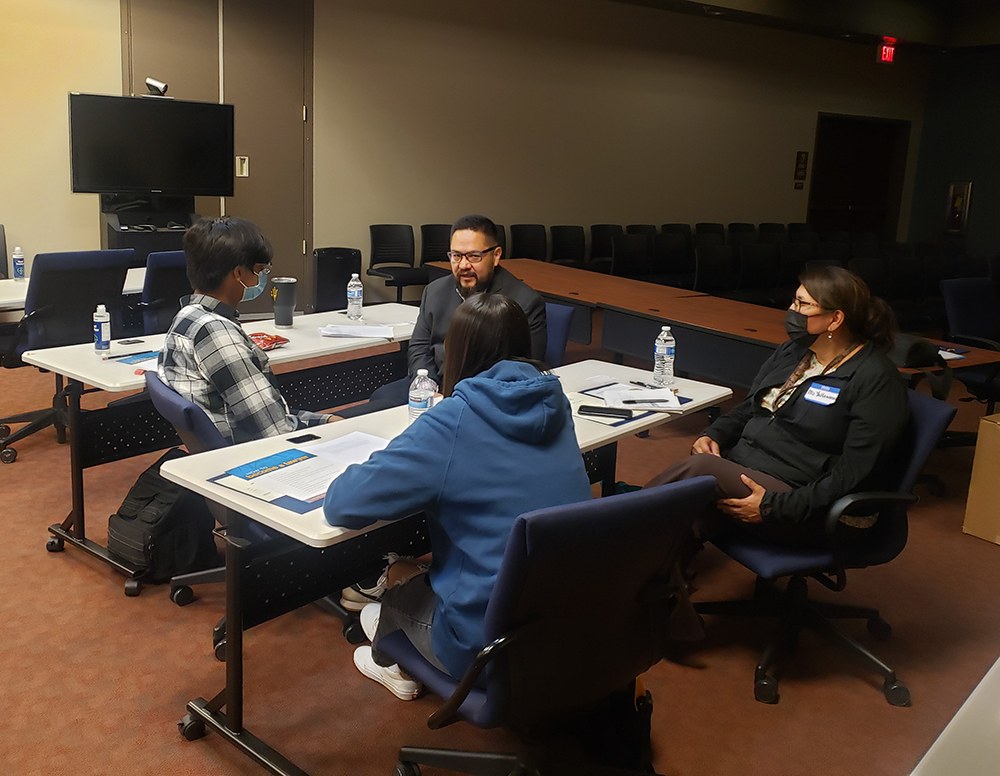
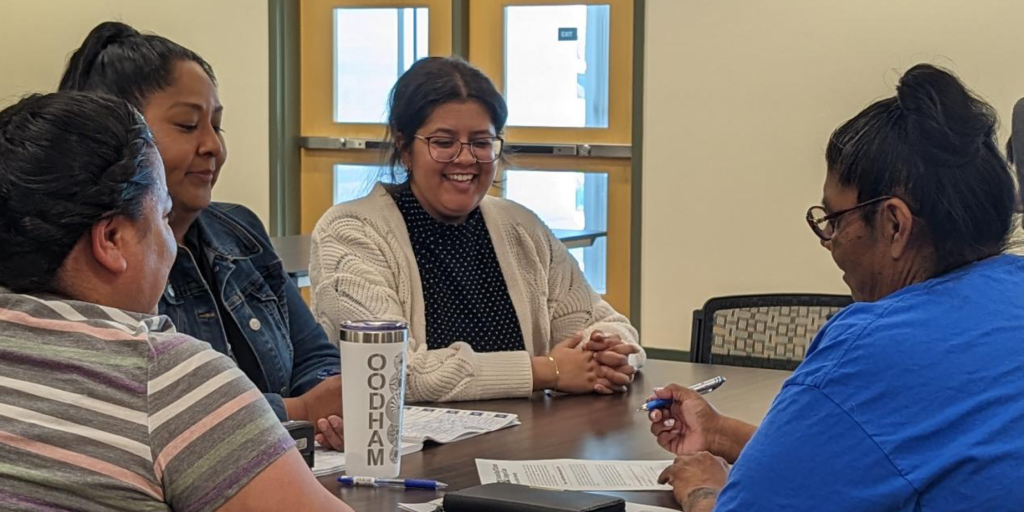
  1. Student attorneys meet with clients one-on-one on the first day to learn the client’s estate planning wishes. Students explain to the client their options under the American Indian Probate Reform Act and under tribal and state law, and then help the client finalize their choices.
  2. After the meetings for the day are over, the students draft the estate planning documents for the rest of the afternoon and into the evening. The documents prepared include wills and health care powers of attorney.
  3. The next morning, the students meet with their clients again to go over the prepared documents to make sure the will and power of attorney reflect what the client asked for.
  4. When the client is satisfied that the documents represent what they want, the client executes the documents before witnesses and notaries, meaning that the client leaves with finished legal documents.

Because the hours are long, students are usually tired by the end but also filled with a sense of accomplishment from handling what are often their first clients.

“One of my clients thought she wouldn’t be able to make certain critical decisions, but I was able to help her settle on what she wanted,” said student attorney Sukhleen Bahl (3L). “She was very happy when she left with a completed will and health care power of attorney.”

Tribal clients are also usually very happy to have a settled estate plan, sometimes first in their family to have one. They share their positive experience with family and friends, thus creating increased demand for the students’ estate planning services.

Advancing public service in Tribal Communities

11 students over the two semesters drafted 60 wills and 56 health care powers of attorney. Students during the fall semester – Samir Grover (2L), Erin Jenkins (2L), Courtney Kamauoha (3L), Molly Lathrop (3L), Julia Weiss (2L) and Joe Wilwerding (2L) – drafted 28 wills and 29 powers of attorney. Spring semester students – Sukhleen Bal (3L), Sierra Porritt (2L), Devorah Kalani (LLM), Christina Bustamante (2L), Hannah Dunham (3L) and returning veterans Kamauoha and Lathrop – drafted 32 wills and 27 powers of attorney.

In addition to helping clients with their estate plans through wills clinics, students also handle probate and estate administration cases. These are cases that are heard in Tribal court, before the Office of Hearing and Appeals (for AIPRA cases), and in State court. While assisting with their clients’ estate needs, student attorneys are exposed to a variety of issues: assisting a client with becoming a personal representative so the client can settle a loved one’s estate, helping a family distribute estate property in a way that is in keeping with the family’s cultural values versus the state’s intestacy plan, protecting inheritance rights, and settling claims with creditors.

“The wills clinics opened my eyes to the large need for those who know how to draft Indian wills to keep Native lands in the hands of the people to which they belong,” said Courtney Kamauoha (3L). 

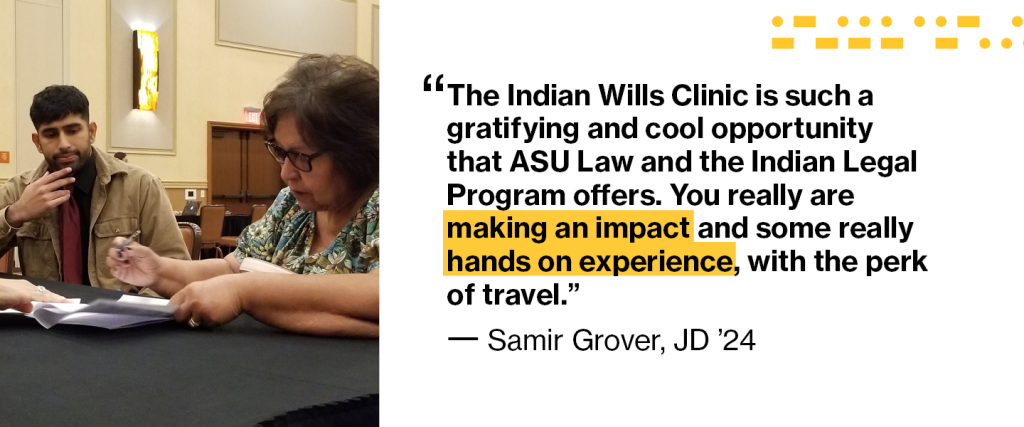
Enrolled in the Indian Wills and Probate clinic, ILP student Samir Grover (2L) enjoyed Professor Burtis’s class that he found intellectually challenging and motivating. “The client experience was incredibly rewarding and provided me with practical knowledge,” said Grover. “Professor Burtis ensures that the class sessions provide a baseline in Indian Law, Estates, and its interaction with AIPRA. She makes sure that student attorneys are fully prepared to meet with clients for drafting wills and we approach every case with not just knowledge but understanding on how to effectively interact and understandingly interact with clients, mostly elders, when helping them through a really significant and important process in advising them and drafting Indian Wills. My favorite part of the class was travelling to Pechanga and Quechan and meeting some amazing clients that it felt so gratifying to help in creating wills and ensuring their estates are protected according to their wishes. The Indian Wills Clinic is such a gratifying and cool opportunity that ASU Law and the Indian Legal Program offers. You really are making an impact and some really hands on experience, with the perk of travel.”

By providing an important service to tribal citizens who often have difficulty finding someone to represent them with estates that can encompass the three jurisdictions, students gain meaningful experience, a sense of purpose, and an opportunity to work in a variety of circumstances.

Wills and Probate at Gila River

The Indian Legal Clinic students in the Wills & Probate section finished up there semester with a wills clinic at the Gila River Indian Community (GRIC) on March 30-April 1. The wills clinic was held at the District 4 Multi-Purpose Facility and was the first one held for the Community.  

The students’ services were appreciated by the GRIC elders. “I’m going to tell my sisters and brothers and my nieces and nephews they should do this because they need a will!” said one satisfied elder.

Great job to ILC students: Sukhleen Bal (3L), Christina Bustamente (3L), Hannah Dunham (3L), Devorah Kalani (LLM), Courtney Kamauoha (3L), Molly Lathrop (3L), and Sierra Porritt (2L).

We appreciate the Gila River Indian Community for their hospitality and hosting a wills clinic at their facilities.

____
Helen Burtis (’07)
Faculty Associate, Indian Legal Clinic, ASU Law

Repatriation of cultural objects

This year, the Indian Legal Clinic (ILC) student attorneys Brittany Habbart (3L) and Ruben Zendejas (3L) prepared a comment on the repatriation of cultural objects for a new Austrian repatriation project created by the Advisory Committee for Guidelines for Collections in Austrian Federal Museums from Colonial Contexts convened by the Federal Ministry of Arts, Culture, Civil Service and Sport (BMKÖS). BMKÖS requested comments and suggestions while Austria is considering new laws and policies about when to repatriate and the process of repatriation for a variety of materials. Certain items within Austria’s collections have a history of colonialism, violence, or otherwise did not have meaningful consent. The country has opened the important discussion about the way museums acquired their collections, including Austria’s federal museums, and how to address those items present-day. 

The ILC comment suggests, “that meaningful repatriation policy consider all cultural items from historically colonized communities to be subject to and open for repatriation; make considerations for formally recognized indigenous governments, as well as other smaller indigenous communities and even, if necessary, individual claimants; and, the burden of proof be not placed solely on Indigenous communities, but on the western institutions themselves. Further we advise the museum to consider the possibility of digital repatriation — the authorization of licenses, copyrights, etc. — where physical repatriation is not wanted, needed, or possible.” 

The Indian Legal Clinic worked with Professor Trevor Reed to prepare the comment.

____
Helen Burtis (’07)
Faculty Associate, Indian Legal Clinic, ASU Law

Job Opportunity: Civil Rights Attorney

The Albuquerque, NM office of Rothstein Donatelli LLP is seeking an associate attorney for its civil rights practice group. The Firm is looking for a New Mexico licensed attorney with at least 2 years or more of litigation experience. The candidate should possess a demonstrated commitment to the welfare of individual clients and maintain the highest quality of legal practice, especially legal research and writing skills. The ideal candidate will have experience litigating civil rights cases and/or representing survivors of sexual abuse. The associate must be skilled in managing complex litigation and providing staff direction.

Rothstein Donatelli has offices in Albuquerque and Santa Fe, New Mexico, as well as in Tempe, Arizona. The Rothstein Donatelli LLP practice areas include civil rights and discrimination law, representation of survivors of sexual abuse, criminal defense, complex civil litigation, appeals and post-conviction work, and Indian law. Rothstein Donatelli is committed to social justice and vigorously protecting the rights of its clients.

Rothstein Donatelli LLP provides equal employment opportunities to all employees and applicants for employment without regard to race, color, ancestry, national origin, gender, sexual orientation, marital status, religion, age, disability, sex or gender identity, results of genetic testing, or service in the military. Equal employment opportunity applies to all terms and conditions of employment, including hiring, placement, promotion, termination, layoff, recall, transfer, leave of absence, compensation, and training. The Firm expressly prohibits any form of unlawful employee harassment or discrimination based on any of the characteristics mentioned above. Improper interference with the ability of other employees to perform their expected job duties is absolutely not tolerated. The Firm is committed to achieving a diverse workforce and an inclusive environment.

Interested candidates should send a resume, references, and writing sample to Manya Snyder at info@rothsteinlaw.com.

Job Opportunities

DOJ Indian Country Assistant US Attorney

  • Tulsa, OK – Application Deadline: May 24, 2023 for priority consideration

FCC Office of Native Affairs – Attorney

FCC Office of Native Affairs – Policy Advisor

DOJ Office on Violence Against Women Tribal Consultation

National Center for Missing & Exploited Children (NCMEC) – Impact Report

Job Opportunity: Senior Attorney

Navajo Nation
Office of Navajo Public Defender
Tuba City, AZ

Closing date: Open until filled

Position no: 243284

Duties and responsibilities: Represents clients, adults and juveniles, in criminal and delinquency proceedings in and out of court. Reviews all court and discovery
documents. Interviews clients; provides information on potential outcomes, defenses, potential consequences, federal prosecution; sentence(s) if convicted; deferred prosecution programs, peacemaking, etc. Develop theory of case and prepare pre-trial motions, responses; replies for trial preparation. Interview and/or depose witnesses. Communicate with prosecutor, probation, service providers. Assist client with referrals, appointments for evaluation, etc. Provide guidance and assistance to court advocates as needed. Prepare, file and complete appeals or Writs to Navajo Supreme Court when necessary. Position requires travel to district and family courts throughout the Navajo Nation.

Minimum Qualifications: 

  • A Juris Doctorate; and four (4) years professional experience as a state licensed attorney. Current
    admission in any state bar with the intention of seeking and securing admission to the Navajo
    Nation Bar Association and either the Arizona, New Mexico or Utah State Bar within one (1) year of
    date of hire.

See full job description: Senior Attorney – Tuba City, AZ

More information: Job vacancy announcement

Job Opportunity: Attorney

Navajo Nation
Office of Navajo Public Defender
Window Rock, AZ

Closing date: Open until filled

Position no: 244832

Duties and responsibilities: Represents clients, adults and juveniles, in criminal and delinquency proceedings in and out of court. Reviews all court and discovery documents. Interviews clients; provides information on potential outcomes, defenses, potential consequences, federal prosecution; sentence(s) if convicted; deferred prosecution programs, peacemaking, etc. Develop theory of case and prepare pretrial motions, responses; replies for trial preparation. Interview and/or depose witnesses. Communicate with prosecutor, probation, service providers. Assist client with referrals, appointments for evaluation, etc. Provide guidance and assistance to court advocates as needed. Prepare, file and complete appeals or Writs to Navajo Supreme Court when necessary. Position requires travel to district and family courts throughout the Navajo Nation.

Minimum Qualifications:

  • Juris Doctorate.
  • Current Admission in any state bar with the intention of seeking and securing admission to the Navajo Nation Bar Association and
    either the Arizona, New Mexico or Utah State Bar within one(1) year of date of hire.

See full job description: Attorney

More information: Job vacancy announcement

The inaugural San Manuel Band of Mission Indians Externship recipients

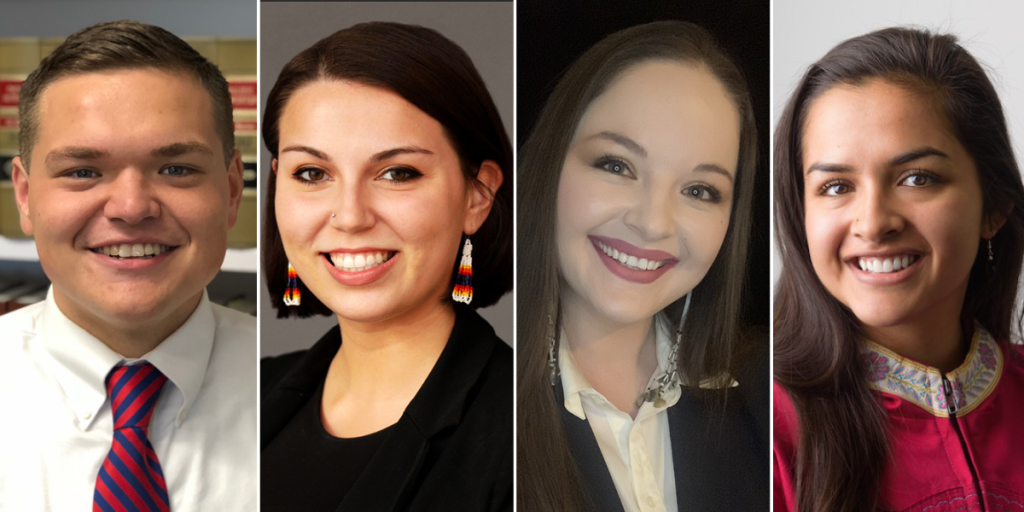
ASU Law students Chad Edwards (3L), Brittany Habbart (3L), Lena Neuner (3L) and Ravynn Nothstine (3L) make up the inaugural class of the Indian Gaming and Tribal Self-Governance Programs’ San Manuel Band of Mission Indians Externship Program. This externship program, with funding provided by the San Manuel Band of Mission Indians, allows promising future leaders to pursue experiences working to further Indian gaming or tribal self-governance, while earning valuable credit hours through a paid externship. 

Edwards worked to further economic development in Indian Country at the Tohono O’odham Gaming Office with Executive Director Jerry Derrick (’91). Edwards is standing in front of the Tohono O’odham Nation “White House,” which houses the Executive and Legislative branches of the Tohono O’odham Nation in Sells, Arizona. 

Habbart gained a behind-the-scenes look at federal agencies while working with the Department of the Interior Solicitor’s Office in the Division of Indian Affairs. Neuner worked to protect tribal cultural and natural resources at the Ridges to Riffles Conservation Fund, and Nothstine worked on behalf of the Native American Rights Fund in their Alaska office.

Applications for the fall externship program are open to second and third-year students seeking a juris doctor, current LLM students, and current MLS students. 

For more information, please contact Theresa.Bealieu@asu.edu.   

Submit your application for The Yuhaaviatam of San Manual Nation Externship Program.

Deadline: June 23, 2023

We rise by lifting others

On April 4, two ILP alumni were honored in the Native American 40 Under 40 awards. Congratulations to Krystalyn Kinsel (’15) and Alexander Mallory (’19)! The Native American 40 Under 40 awards represent the best and brightest emerging Indian Country leaders who serve in a variety of fields.

ILP directors and alumni traveled to Las Vegas to celebrate this amazing recognition.

We’re so proud of you both!

Spark Indigenous Joy

The Federal Bar Association Indian Law conference is a unique time when law practitioners and advocates come together and have an in-depth discussions about the future of Indian Country. It is also a time when organizations that serve the same purpose gather to acknowledge and celebrate Indigenous excellence.

ASU Law’s ILP family met at Sandia Resort for its 23rd annual Alumni & Friends Awards Ceremony and Reception. It was a night full of heartfelt messages and success stories to celebrate this year’s award recipients. Rebecca Ross (’10) received the Alumni Service Award and Stephanie Sfiridis (’16) received the Emerging Leader Award.

Six ILP family presented at this year’s Federal Bar Association Indian Law Conference. On day 1, Faculty Associate Paul Spruhan presented on a panel “Protection of Tribal Sovereignty and Self-Determination Before the U.S. Supreme Court,” ILC Director Patty Ferguson-Bohnee and Liz La quen náay Medicine Crow (’05) presented on “Access to the Ballot Box: Protecting Native American Voting Rights.” On day 2, Jacqueline Bisille (’14) and Rani Williams (’18) presented on “Efforts to Address the Intergenerational Impacts of Federal Indian Boarding School Policies,”Sfiridis presented on a panel “Improving the Land into Trust Process and Best Practices for Tribal Realty and Land Use” and Linda Benally (’03) joined colleagues for a discussion about bias and improvement to support Native American women attorneys during the final presentation “Ethics Panel-Elimination of Bias.”

The National Native American Bar Association (NNABA) also held its annual meeting followed by its 50th Anniversary Celebration with ILP alumni serving on the board: Native Vote Fellow Torey Dolan (’19) as director and Sarah Crawford (’19) as secretary. Native Vote Fellow Blair Tarman-Toner (20’) is NNABA’s newly elected Young Lawyer Representative to the American Bar Association. 

Eight ILP students received the NNABA bar scholarship. Congratulations rising grads: Chad EdwardsAshleigh FixicoBrittany HabbartMichael LaValleyLena NeunerRavynn NothstineAutumn Shone and Chanel Simon.

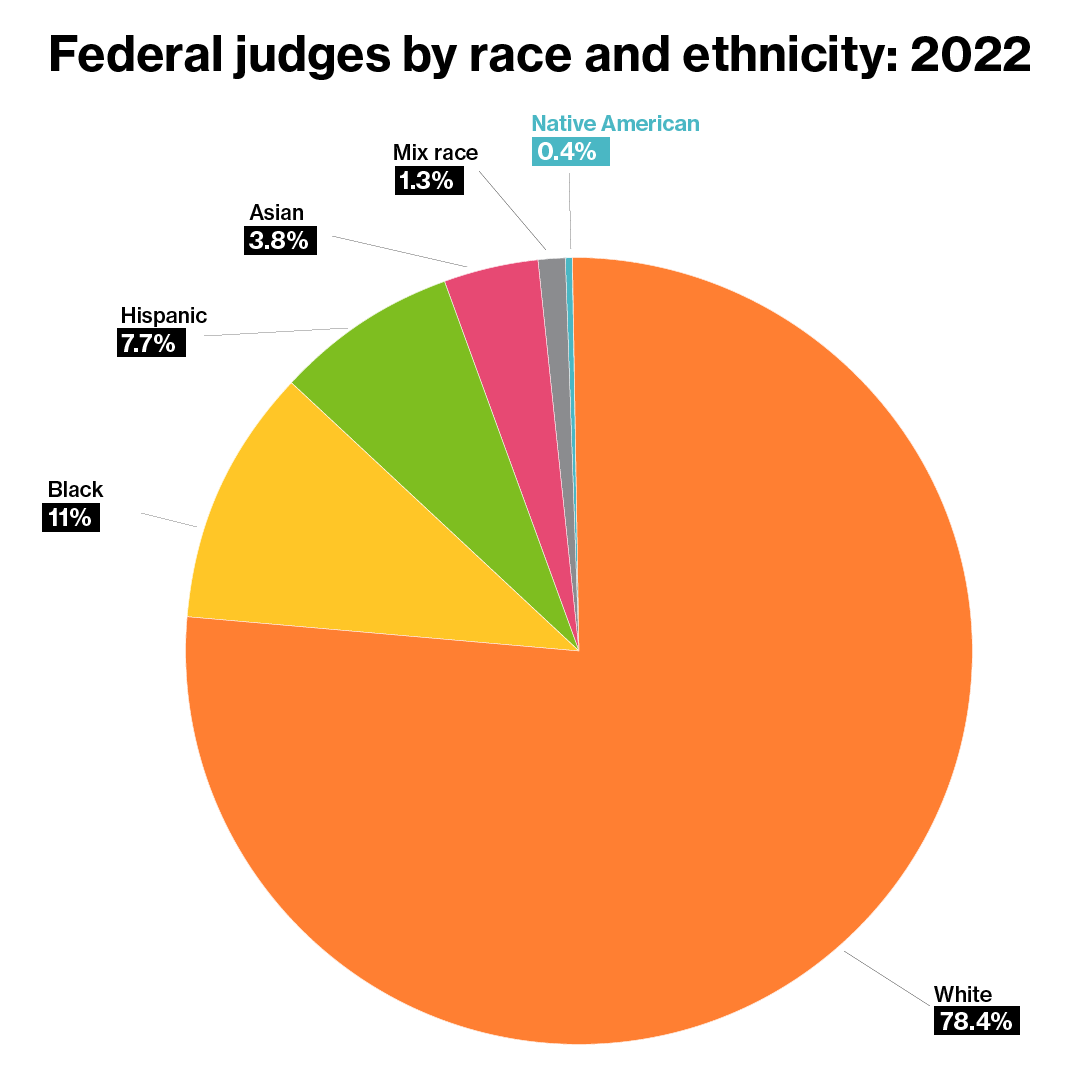
Native American legal warriors and trailblazers shared their wisdom from the early days of Indian Law, inclusion disparity and the need to “uplift our law practice,” as said by Thomas Fredericks, first NNABA president. ILC Director Patty Ferguson-Bohnee , Linda Benally (’03) and Diandra Benally (’05) were recognized as past presidents of NNABA. The Honorable Diane Humetewa (’93) is one of the most recognizable faces in Indian Country for being the first Native American woman to sit on the federal bench. During her special address, Judge Humetewa reflected on her historic appointment and how she felt witnessing the confirmation of two Native American women to the federal bench: Judge Lauren King’s appointment in 2021 as Washington’s first Native American federal judge and Judge Sunshine Suzanne Sykes’ appointment in 2022 as California’s first Native American federal judge. 

“I know that Judge King and Judge Sykes are deeply committed to advancing opportunities for Indigenous law students and lawyers, and they each bring a meaningful voice to their respective district courts on which they sit. And I know through us, we hope that you see that pathways to judicial positions are actually possible.” 

Our Indian Law community is filled with extraordinary advocates who walk with a special vision and purpose, a responsibility that our ancestors tasked us with. We enjoyed seeing everyone and we look forward to elevating the successes of Native American representation in the law.