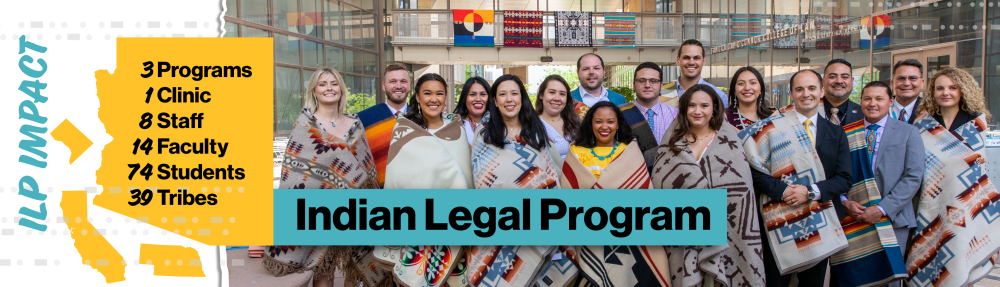
TEMPE, Ariz. — Three women who hope to shape the future of education in Indian law are the first to enter the thesis track of the LL.M. (Master of Laws) program in Tribal Policy, Law, and Government at the Sandra Day O’Connor College of Law at Arizona State University.
They include a member of the Navajo Nation, a member of the Acoma Pueblo in New Mexico, and a woman who grew up in Hawaii.
“These are tremendously talented, well-qualified young lawyers, who will pursue scholarly writing, be given the opportunity to teach, and to participate in the intellectual life of the College,” said Patricia White, Dean of the College. “This program provides training for young scholars who will enter the world of Indian law education.”
Kevin Gover, a professor in the Indian Law Program and former Assistant Secretary of the Interior for Indian Affairs, praised the rich backgrounds of the candidates.
“Their interest in art, culture, and international affairs shows their devotion to new ideas and new perspectives,” Gover said. “Their diverse backgrounds, their obvious academic ability, and their various experiences will bring a new atmosphere to the classroom and to the law school as a whole.
“Young scholars like these will generate a new level of scholarship that transcends traditional legal scholarship and moves into a dynamic and transdisciplinary approach to Indian Law and Indian policy.”
Kate Rosier, director of the Indian Legal Program, said the master’s candidates also will be an asset to the J.D. students.
“The LL.M. students will enrich the classroom and provide valuable information about their legal careers with the law students,” Rosier said. “
One of the candidates, Wenona Benally, a member of the Navajo Nation, was inspired to pursue a career in law after hearing stories of her great-grandfather being sent on a forced relocation march. After graduating summa cum laude from Barrett, The Honors College at ASU with a bachelor’s degree in English, Benally completed her master’s in Public Policy along with her Juris Doctor at Harvard University in 2006. While at law school, she spent her breaks serving as an intern and visiting researcher at the Jumbunna Indigenous House of Learning at the University of Technology, in Sydney, Australia. Her mentor there, Larissa Behrendt, is a professor of law and aboriginal studies, director of the House of Learning, and advocate of indigenous rights, a combination that appealed to Benally. “From the first time I worked with her, I knew that was my passion,” Benally said. After finishing at Harvard, Benally went to work in the Portland office of the Washington, D.C.-based firm, Hobbs, Straus, Dean & Walker, focusing on trust reform, health care and financial issues. “I enjoyed the work, but I wanted to do more with public policy,” she said. “I wanted to get into academia and share what I’ve learned with other people. I’d love to teach a class on the topic.” She plans to sharpen her analytical skills and increase her knowledge of Indian law issues by investigating the ways in which foundational principles of federal Indian law and tribal law in this country may be transformed to strengthen and advance the indigenous self-government rights agenda being pursued in countries like Australia and Canada. Breann Swann is the fourth generation of Puerto Rican, Japanese and Irish ancestors to grow up in Hawaii. She began taking hula as a young girl, and over the years, her kumu hula (hula teacher) instilled in her an appreciation of the rights of indigenous peoples. In third grade she decided she wanted to be a lawyer. The combination has steered her to a career in Native law. Swann earned her bachelor’s degree in English from Yale University and a J.D. from the University of Southern California — Gould School of Law in 2004. After graduation, she worked on labor and employment law in the Los Angeles office of Thelen, Reid, Brown, Raysman & Steiner, a national firm with large offices in New York and San Francisco. “I was always interested in academia,” Swann said. “I was interested in the issues of Constitutional rights, citizenship. My friends were surprised I practiced law for three years.” She plans to research Native American tribal self-governance in order to continue her interests in analyzing the effects of colonization on indigenous communities. “I’m interested in how rights are recognized, how sovereign nations interact with the federal government, how it is different in Polynesia and Latin America.” She taught a hula class at Yale and continues working through her halau hula (hula school) to climb the three-step ladder to become a kumu herself. “It is very difficult, with many requirements, including fluency in Hawaiian.” She has established a scholarship for gifted students at her elementary school which has paid for more than 15 children to attend summer arts programs, including one in art, one in drama and three in ukulele. She is “wide open” about her future, and thinking she may end up teaching in Latin America, where her boyfriend, who has a master’s degree in radical political philosophy and is working on a doctorate, could continue his research on indigenous revolutions. Lynn Trujillo, whose roots are in the Taos, Acoma and Sandia pueblos in New Mexico, was enrolled and raised in the Sandia Pueblo. Her life is an amalgamation of art, religion and law. She earned her bachelor’s degree in studio art (drawing, painting and sculpture) and religion from Dartmouth College. “I love to paint,” Trujillo said. “When I think about how I approach issues and having perspectives, I think the combination of art and law makes sense. “When I’m working on a sculpture, I’m thinking three-dimensionally. There are components that feed into a bigger piece of work. I’m always thinking, ‘Where does this fit into my other work?’ Trying to push the envelope. Or with a painting, thinking about all the components that make up a really good painting and how it makes sense in that piece. “In regard to law, you’re looking at different perspectives, coming up with certain solutions. I think it sort of fits for me. “I feel I’m doing my best work and am happiest when I’m actively engaged in both areas.” She said the study of religion helped her question the things she learned as a traditional Native person raised as a Catholic, and she was fascinated with Eastern religions like Buddhism, Hinduism, Taoism and Judaism. After college, she worked on the Committee on Indian Affairs for the U.S. Congress. “Sitting in on hearings, seeing tribes come to Capitol Hill, then coming back home to Sandia, where we had a non-Indian lawyer representing our tribe, I said, ‘Where are the brown faces?’ “I had never thought about going to law school, but I thought, ‘I can complain about it or I can do something.’ I was the first person from my tribe to go to law school.” She earned her J.D. at the University of New Mexico in May 2001, then worked with Professor Kevin Gover at Steptoe & Johnson in Washington, D.C. She then went on to serve as general counsel for the New Mexico Indian Affairs Department, a state office charged with the lead role in carrying on the state’s relations with the 23 tribes of New Mexico. In 2004, she was asked to serve as her tribe’s first general counsel. “I really enjoyed it,” she said. “It was an exciting time. I learned the most and grew the most as a lawyer and a person.” She was drawn to the LL.M. program because she wanted to do more work in policy. “Policy shapes law and law shapes policy,” she said. “If you just do one, you don’t get anywhere.”
Indian Law Curriculum for schools
We are partnering with the Arizona Foundation for Legal Services and Education and Maricopa Community Colleges to develop an Indian Law curriculum for schools. At first, we are aiming for junior high, but that may change. I may have spoken to some of you in the past about this endeavor and/or received your feedback on it — and thank you for your input.
The survey link below is very short. We are asking for 5 topics you think should be included in the objectives. Please do pass it to anyone and everyone for their input as well. We want to hear from students, teachers, legal professionals, tribal members, adults, kids, and more.
This is our first step in designing the objectives for the program, so please answer and pass it along. Thank you.
http://www.zoomerang.com/survey.zgi?p=WEB226S2DKJUZT
K Royal Director of Pro Bono Programs and Student LifeSandra Day O’Connor College of LawP.O. Box 877906 Tempe, Arizona 85287-7906 480.727.8979
2nd Annual NALSA Golf Tournament
Announcing the
2nd Annual ASU NALSA Golf Tournament
Sponsored by the
Native American Law Students Association
Sandra Day O’Connor College of Law
Arizona State University
Date: Saturday, November 3rd, 2007
Time: 7:30 AM Shotgun Start
Place: The Foothills Golf Club, Awahtukee (Phx), AZ
Course info: http://www.thefoothillsgc.com/
Entry Fee: $100 per player
Fee includes: Lunch, green fees, cart, range balls and 1 raffle ticket
Format: Men, Women, and Coed (Scramble format). Teams consist of 4 players but all golfers are welcomed and entries with less than 4 players will be consolidated into teams of 4.
Contests: Longest drive, closest to the pin, putting contest, raffle, and skins (side bets).
Prizes: Championship and runner up prizes to Men’s, Women’s, and Co-ed divisions.
Deadline: Entries will be limited to the first paid 100 golfers. Paid entries must be recieved on or before Wednesday, October 24th, 2007 (No exceptions). ASU NALSA will adhere to this strict deadline in order to facilitate scheduling with the golf course. Please see attached sign up form for payment.
For more info, contact: JC at clarkEjerome32@yahoo.com
In addition, NALSA recognizes there could be non-golfers who would like to contribute. There is an opportunity for hole sponsorship. Golf hole sponsorships are $100 per hole or if you’d like to sponsor current NALSA members who play golf, please contact JC at the e-mail address above.
JOB – Alaska Tribal Health Consortium
There is an attorney position available in the General Counsel’s Office of the Alaska Tribal Health Consortium (ANTHC). ANTHC is a great organization that has a role in managing the entire Alaska tribal share of the IHS’s budget for delivery of health care under the Indian Self Determination and Education Assistance Act (p.l. 93-638). For more information, please visit:
http://www.anthc.org/mod/jobweb/pdf/07-2-323.pdf
JOB – Director of the U’s AIRC
Director,
The University of Utah American Indian Resource Center (AIRC)
QUALIFICATIONS
Candidate must possess a Masters degree in any appropriate academic field with at least three years experience working with American Indian/Alaska Native/ Indigenous students and their communities. Candidate must have knowledge of American Indian Tribal governments, cultures, economy, education, religion and traditions especially the Utah Tribes and Nations. A working knowledge of postsecondary education recruitment techniques and strategies, competency in retention and persistence programs and an understanding of contemporary American Indian issues and cultural awareness are essential requirements. A successful candidate must be able to work cooperatively with American Indian Nations in the Intermountain West. Candidate must have skills in word processing, spreadsheet applications, e-mail communications, data collections and analysis. Excellent verbal and written communication skills are necessary as well as strong presentation skills. A preference will be given to applicants with experience in a University setting, and with demonstrated experience writing and securing public and private grants.
JOB DUTIES
The Director will be involved in recruitment of American Indian students and development of programs for retention of American Indian students in undergraduate and graduate programs at the University of Utah. Retention programs will include development of mentoring programs, development of campus cultural activities, development of a website/program of activities, and supervision of the American Indian Resource Center. The Director will consult with Tribal educational organizations, such as Title VII, about access and participation in higher education programs. The Director will manage programs and coordinate activities across campus that serve American Indian students ~ often working with the American Indian Administrative Program Coordinator in CESA, the Center for Ethnic Student Affairs ~ with the AIRC serving as a gathering place for these academic, social, and cultural activities. The Director will promote American Indian initiatives and retention on campus through development, such as grant writing and other fund raising.
Applicants must submit an online Human Resources application form and resume for Job 030020 at:
http://www.hr.utah.edu/joblist/
The University of Utah is fully committed to policies of nondiscrimination and equal opportunity, and vigorously pursues affirmative action in all programs, activities, and employment with regard to race, color, national origin, sex, age, and status as a person with a disability. Religion, sexual orientation, and status as a disabled veteran or veteran of the Vietnam era also are protected under nondiscrimination and equal opportunity employment policies.
The ILP Welcomes New Students!
The ILP would like to welcome several new students to the College of Law!
First Year Students
- Derrick Beetso (Navajo)
- Amanda Burley (Creek)
- Sarah Cedar Face (Oglala Sioux)
- Matthew Colton (Cherokee)
- Jason Croxton (Navajo)
- Pat Kincaid (Southern Cheyenne)
- Daniel Lewis (Laguna)
- Bradley Martin (Hopi)
- Wendell Matt (Salish/Kootenai)
- Dallin Maybee (Seneca)
- Andrea Patton (Sac&Fox)
- Suzanne Trujillo (Laguna)
- Naomi White (Navajo)
LL.M. Students
- Wenona Benally
- Breann Swann
- Lynn Trujillo
M.L.S. Students
- Rochelle Trimble
- Carolyn Loder
Visiting Students
- Paul Silvey
Arizona Indian Court Judges Association Meeting
SAVE THE DATE — AUGUST 31, 2007
The AICJA are scheduling our annual meeting on this date, so please schedule accordingly and plan to attend.
Time: 8:00am-(to be determined by topics/agenda items submitted)
Location: TBA
Also, please submit any topics or items that you would like to be considered for the agenda.
This meeting is going to be considered a “re-grouping” session to get back on track and develop some concrete ideas on what kind of activities we would like to see the Association conduct and to hopefully develop some much needed trainings for the Tribal Court Judges and related staff.
Please plan on attending and also start soliciting your colleagues for their participation as well.
If you or new judges employed by you have not yet signed up for membership in the Association, please feel free to contact Judge White at (760) 572-5552 or c.white@quechantribe.com and she will provide you with any necessary information prior to the meeting.
2007 ILP Welcome Dinner
You are Invited to the
Indian Legal Program’s
Welcome Dinner
Join the ILP faculty and staff for a casual dinner and meet our new entering class!
Join the ILP faculty and staff for a casual dinner and meet our new entering class!
Friday, August 24th
6:00 p.m.
Sandra Day O’Connor College of Law
Rotunda
Please RSVP by August 20th to
Kate Rosier at kathlene.rosier@asu.edu or Tana Fitzpatrick at tfitzpa1@asu.edu
Sonia Reyna – Legal Assistant Today Magazine

Agua Caliente will not appeal
See the article below regarding Agua Caliente’s decision not to appeal its case to the Supreme Court.
Indian tribe settles with state on reporting political donations
By James P. Sweeney
Copley News Service
07/09/2007
SACRAMENTO — Ending a five-year legal fight that threatened to punch a big hole in California’s political disclosure law, a Palm Springs Indian tribe has agreed to fully abide by the state’s campaign and lobbying rules.
In a settlement reached quietly with the state’s Fair Political Practices Commission, the Agua Caliente band also waived its sovereign immunity against prosecution for future violations of those rules.
And the tribe agreed not to appeal a Dec. 21 decision by the California Supreme Court, which concluded that the state’s need to protect its elections and political system trumped the tribe’s sovereign immunity from lawsuits. This means the Supreme Court ruling, reached on a 4-3 vote, stands.
“It is a big win for the state, a big win for the people and a big win for disclosure,” said Robert Stern, president of the Center for Governmental Studies and a co-author of California’s landmark Political Reform Act.
“This was a very important case because the tribes are so heavily invested now in campaigning in California,” Stern said. “If it had gone the other way, disclosure would have taken a huge hit.”
Agua Caliente Chairman Richard Milanovich said he was pleased with the settlement and happy to have the litigation behind him. He noted that three justices on a sharply divided state Supreme Court had agreed with the tribe.
“If we were to take this any further, say up to the U.S. Supreme Court, the makeup of the court today is such that it did not look very favorable,” Milanovich said.
A loss before the nation’s highest court would have had implications nationwide and would have opened another crack in tribal sovereignty.
“There are many tribal organizations and tribes that are going to be pleased that we took the action that we took because this would have had a blanket effect across the country,” Milanovich said. “So, was this the right case to try at the time? Probably not.”
The state sued in the summer of 2002, seeking to impose a more than $7.5 million fine against the tribe for failing to report some contributions and disclose others by the state’s deadlines. Nearly all of the state’s other tribes willingly comply with the political reporting law.
In the settlement, Agua Caliente agreed to pay the state $200,000. While the amount represents a small fraction of the original penalty sought, both Stern and Karen Getman, the former FPPC chairwoman who initiated the case, said it represents one of the largest fines the agency has ever collected.
“That’s a very big fine . . . but this case wasn’t about the money,” Getman said. “The issues were much bigger.”
As Indian casinos have grown into a nearly $8 billion industry in California, wealthy tribes have become political heavyweights that routinely give six-figure and occasionally multimillion-dollar contributions to candidates and campaigns.
Agua Caliente is one of the state’s biggest political donors, giving generously to candidates of both major political parties and even bankrolling a statewide ballot measure, the unsuccessful 2004 Indian gaming initiative, Proposition 70.
The state’s lawsuit alleged the tribe failed to report more than $8 million in campaign contributions within timelines designed to let the public know who is backing candidates and ballot measures.
Agua Caliente argued that it was reporting all the required information on its Web site. But state attorneys alleged that some contributions were not disclosed until long after the elections were held.
In one case, investigators said the tribe failed to report a six-figure contribution in 2002 to Proposition 51, which would have provided $15 million a year for transportation projects including a rail line from Los Angeles to the Palm Springs area, where Agua Caliente operates two casinos.
Nonetheless, the state’s case looked to be a legal long shot. It was almost impossible to overcome the legal shield provided by a tribe’s sovereign immunity, many warned Getman and her staff.
Then-Attorney General Bill Lockyer declined to represent the FPPC in the case, forcing the agency to hire private counsel. After the FPPC won an early round, Lockyer reconsidered and began filing briefs in support of the commission. But a private attorney — Charity Kenyon of Sacramento — remained the lead counsel.
“Everyone at the FPPC should feel more than a little vindicated,” Getman said yesterday. “It took a lot of hard work, a lot of guts. . . . It was a very important statement that the commission had to make.”
The issues in play could be kept alive by a parallel case pending against the Santa Rosa Tachi tribe of Lemoore, although that seems unlikely. The Santa Rosa litigation has been on hold pending the outcome of the Agua Caliente case.
Santa Rosa Chairman Clarence Atwell and the tribe’s attorney could not be reached to comment yesterday.
Kathryn Rand, a law professor and co-director of the Institute for the Study of Tribal Gaming Law and Policy at the University of North Dakota, said the case may illustrate a new relationship developing between states and tribes.
“On the face of it, the application of state law to a tribe is absolutely a slam dunk in favor of the tribe,” Rand said. “But given that the tribe has involved itself in state politics to the extent it has, it makes the issues a little trickier.
“I think we’re going to see more of that as Indian gaming continues to grow and remain controversial. We will see the usual rules of tribal-state interaction adapting to this new environment.”