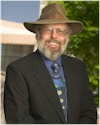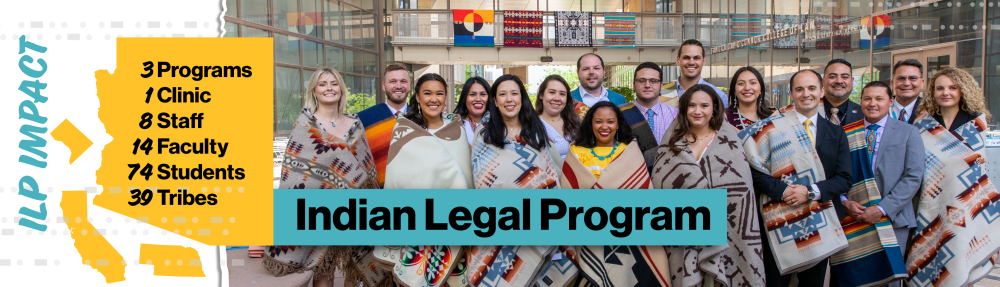
Tsosie quoted in Indian Mascot article

Native community divided on mascots
Paola BoivinThe Arizona RepublicFeb. 1, 2008 11:06 PM

Lost in the enthusiasm of Super Bowl XLII is a story line without pompoms and foam fingers: Many local Native Americans are struggling to pass a metaphoric peace pipe to an organization that allows team imagery viewed as demeaning by many tribes.”It is, simply, inconsistent with the human right of people,” said Rebecca Tsosie, the executive director of the Indian Legal Program at Arizona State University’s Sandra Day O’Connor College of Law. Sunday’s game is expected to attract protesters who question the NFL’s tolerance for the mascots of the Kansas City Chiefs and Washington Redskins. The D.C. franchise is the most controversial and the subject of a petition filed at the U.S. Patent and Trademark Office to cancel the trademark. Many in Arizona’s Native American community feel conflicted about the league, which has supported their causes in other ways. In January, the Super Bowl Host Committee sponsored a three-day Arizona Indian Festival in Phoenix that attracted 22 tribes and showcased art, crafts and musical and dance performances.The NFL Players Association has had a long relationship with the Johns Hopkins Center for American Indian Health, and the NFL was one of the few professional organizations that embraced American Indians in its early years. “The Cardinals,” league spokesman Greg Aiello said, “are very active in the Native American community in the Phoenix area.”Additionally, the Pima and Maricopa tribes are hosting the New York Giants at Sheraton Wild Horse Pass Resort & Spa on the Gila River Reservation. “That’s nice, but it doesn’t excuse everything,” said Suzan Shown Harjo, the president and executive director of the Morning Star Institute, a national Indian-rights organization. “The offender shouldn’t be the one to tell us what offends.”The NFL had an early relationship with American Indians. Its first league president was Olympic track standout Jim Thorpe, a Sac and Fox Indian whose nickname was Wa-tho-huck (Bright Path). During the 1922 and 1923 seasons, an entire team of Native Americans including Thorpe – the Oorang Indians of LaRue, Ohio – played in the league.The first 1,000-yard rusher in the NFL was a Native American. Beattie Feathers was a Chicago Bears rookie in 1934 when he hit the milestone. Others who have come through the league include Hall of Fame halfback Joe Guyon, a member of the Chippewa tribe, and Sonny Sixkiller, a University of Washington standout who played briefly with the Los Angeles Rams. In Arizona, most high schools on reservations have football teams, and their popularity is beginning to match that of the beloved basketball programs.For Val Northrup, who sold crafts at the Arizona Indian Festival, she has no trouble seeing Native American imagery used for team logos and mascots.”At least they know we’re out there,” said Northrup, who lives on First Mesa on the Hopi Reservation. Several booths down, Alison Francisco of the Tohono O’odham Culture Center and Museum bristled.”Am I bothered?” she said. “I think that ‘bother’ is not a strong enough word that fits how much it affects us. It doesn’t make me angry, it doesn’t make me sad, it makes me feel separate.”Francisco believes the NFL’s Chiefs and Redskins are “false representing” themselves.”Walk around here, you don’t see people dressed like that. Maybe the dancers, but they’re interpreting dances from long, long ago,” she said. “What the games are doing aren’t interpreting dances, so why?”No one should be more divided than Nick Lowery. The 17-year NFL kicker is the president of Nation Building for Native Youth, a leadership program for young Native Americans, and has spent many years working with the American Indian community.Lowery said he has met many tribe members who told him they are fine with the symbols “as long as it honors us and treats us with respect.”Jim Warne, a member of the Oglala Lakota Sioux Tribe, understands the ambivalence on the reservation. He grew up in Arizona, played football at Mesa Community College and Arizona State before making a brief stop in the NFL. He now serves as the director of the Center for American Indian Rehabilitation and is an actor and stuntman in Hollywood.”I know about stereotypes because I’m never the guy asked to play the nerdy Ph.D.,” he said. “The NFL has done a lot of good things, but that doesn’t mean it gives them a free pass to not address the issue, because until they do, many Native Americans will hold it against them.”NFL Commissioner Roger Goodell has said little about the issue but rankled many Native Americans after he scolded Washington running back Clinton Portis for defending Michael Vick’s dogfighting ring.”Dogfighting’s bad, but they ignore the genocide of Native Americans?” said David Tom, a member of the Navajo Nation. “Redskins is not just a reference to skin tone. It’s trappers bringing Indian scalps to sell. It’s blood. It’s hard to understand how the NFL can be so nonchalant.”The debate about mascots has its roots in the Lanham Act of 1946, when Congress outlawed trademarks that disparaged persons, living or dead.That was the backbone of a petition filed in 1992 with the U.S. Patent and Trademark Office by a group of Native Americans. The office backed the petition, but it was overturned on appeal. That paved the way for the current petition, filed by six American Indians ranging from 18 to 24.Many believe the Native American community is sending mixed signals. A Peter Harris Research Poll in 2002 reported that 83 percent of Native Americans interviewed on reservations said they didn’t believe pro teams should stop using Indian nicknames, mascots and symbols.”I don’t know who they’re interviewing. They need to continue listening to us,” Francisco said. “Because just like football is going to stay here, we’re going to stay here, too.”
Gover Bids Farewell to Law School

Gover bids farewell to law school:`This is what I’m supposed to do’

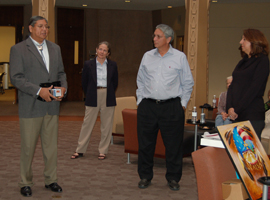
Among the guests at Kevin Gover’s farewellparty were, from left, Jacob Moore, of ASU’sOffice of Public Affairs, Patricia White, deanof the College of Law, Gover, and SandraFerniza, also of the Office of Public Affairs.

Colleagues, students and friends of Kevin Gover, a professor of the Sandra Day O’Connor College of Law and co-executive director of the American Indian Policy Institute at Arizona State University, honored him with symbolic gifts and fond congratulations during a farewell party on Nov. 26.

Gover, a former Assistant Secretary of the Interior for Indian Affairs, is returning to Washington, D.C., to accept an appointment as director of the Smithsonian’s National Museum of the American Indian, effective Dec. 2.

Gover, who will remain a professor at the law school on leave for the duration of his time at the museum, will be welcomed back with open arms whenever he chooses, said Patricia White, dean of the College of Law.

“I want to say how excited we are for Kevin and how proud we are of Kevin and, more importantly, how sad we are for ourselves that Kevin will be leaving,” White said. “Kevin’s presence here has been a wondrous thing for all of us. He has contributed to this school in innumerable ways, as a fabulous teacher and a wonderful mentor to lots and lots of students, and he has been particularly important to the students in the Indian Legal Program.”

One of them, Joe Sarcinella, a second-year law student, presented Gover with an acrylic painting from the Native American Law Student Association, which was made by Phoenix artist Joseph Wolveskill. “You are very important to us,” Sarcinella told Gover. “We’re very happy to have had the chance to study with you.”

Gover, who practiced law in Washington, D.C., and Albuquerque before serving as Assistant Secretary of the Interior for Indian Affairs, joined the College of Law in 2003.

“We didn’t come here with any thought in mind that this was a way station, or that we were just passing through, but rather with the expectation and hope that this would be a place where we would do something completely different, something that seemed worthwhile, important and noteworthy,” said Gover, who also is an affiliate professor in the American Indian Studies Program at ASU. “My hopes and my expectations were not only fulfilled, they were exceeded.

“It means a great deal to be accepted here, into such an elite, intellectual, remarkable family.” Complimenting his colleagues in the renowned Indian Legal Program, Gover said he was certain the program would continue to blossom, and he praised the American Indian Policy Institute as one of the most important such enterprises in the country.

Pat Mariella, the institute’s director, presented Gover with a plaque and thanked him for his leadership, while Eddie Brown, the institute’s co-executive director with Gover, gave him an ASU polo shirt to remind him of his academic roots.

“It’s been a real pleasure,” Brown said. “Kevin because the mastermind of many of the ideas that we developed over the last few years.”

Jacob Moore, tribal relations coordinator for the ASU Office of Public Affairs, gave Gover a Tohono O’odham basket, then joked, “We know he’ll have lots of artwork around him, so this is something to remember us by.”

Gover said his desire to continue helping Native people tell their stories led, in part, to his decision to accept the appointment to the Smithsonian.

“This museum is a place where we can really reshape Americans’ understanding of who Indians are, of who they were and who they’re going to be,” said Gover, who grew up in Oklahoma and is a member of the Pawnee Tribe. “And that’s heady stuff, that’s a big deal to me because there’s so much misunderstanding.”

He also said the new job “seemed like what I’m supposed to do now. I’m very hopeful that it won’t be too long that it seems I’m supposed to come back. I really do like it here, in no small part because of our students.

“I look forward to when I’m in my rocking chair, and I say, `Oh, yeah, that was my student.’ I know the contributions these students will make,” he said.

Article by Tsosie

Rebecca Tsosie and Joan McGregor were Guest Editors of the The Symposium issue of The Journal of Law, Medicine & Ethics. Professor Tsosie’s article “Cultural Challenges to Biotechnology: Native American Genetic Resources and the Concept of Cultural Harm”
Volume 35:3, P. 396, Fall 2007 is featured in the Journal.

Professor Clinton presents at AALS

Professor Robert Clinton will present at the Association of American Law Schools Annual Meeting in January 2008. The theme of this year’s AALS meeting is “Reassessing our Roles as Scholars and Educators in Light of Change.” Clinton’s presentation is part of the Joint AALS and Conference of Chief Justices Workshop on the Courts: Independence and Accountability. His panel is titled “Concepts of Independence and Accountability.”

Gover – New Director of NMAI

Gover to head Smithsonian museum

Kevin Gover, a professor at the Sandra Day O’Connor College of Law at Arizona State University and former Assistant Secretary of the Interior for Indian Affairs, has been chosen to be director of the Smithsonian’s National Museum of the American Indian.

The museum made the announcement this week, saying Gover’s appointment will be effective Dec. 2. “We’re delighted that Kevin Gover will lead the Smithsonian’s National Museum of the American Indian in the next phase of its service to the public,” said Cristián Samper, Acting Secretary of the Smithsonian. “Mr. Gover’s extensive experience in Washington and with Indian communities, his deep interest in and knowledge of Indian history and culture and his commitment to bringing the vast resources of the National Museum of the American Indian to the broadest possible audience will enable him to provide strong and effective leadership to the museum.”

Gover said he was deeply honored by the appointment. “The museum’s mission of educating the public about living Native cultures is an important and challenging one, and I am grateful for the opportunity to build upon the strong foundation created by the museum’s founding director, Rick West,” Gover said. Gover thanked ASU President, Dr. Michael Crow, and Patricia White, Dean of the College of Law, for their support. “I’m grateful that I will maintain an association with ASU and the Sandra Day O’Connor College of Law,” he said. “I will miss my colleagues and students at Arizona State University and my many friends from the Indian nations of Arizona, but I do look forward to serving in a new capacity.”

White said Gover will remain a professor at the law school on leave for the duration of his time at the museum. “The Smithsonian has made a magnificent appointment,” White said. “Kevin Gover is a man of rare talent and integrity. His knowledge of Indian affairs and policy is unmatched, and his interpersonal skills are truly wonderful. “We are proud to have him on our faculty and selfishly wish that he were not taking leave to take on this important post.” White said the College remains committed to maintaining the leading Indian Legal Program in the country and will seek new talent to fill the space left by Gover’s departure.

Rebecca Tsosie, Executive Director of the Indian Legal Program, said Gover is the ideal person to serve as the museum’s next director. “He has the knowledge and skills to lead this important institution, and to work collaboratively with policymakers and tribal leaders on the next phase of the Museum’s development,” Tsosie said. “The entire Nation will benefit from Professor Gover’s leadership, and therefore I am very supportive of Professor Gover’s decision to assume this important position. “Of course, at a personal level, those of us who worked closely with Professor Gover will miss having his daily presence at the law school, and his ever-present wisdom, practical genius, and sense of humor.” Tsosie said the faculty, students and staff of the Indian Legal Program, as well as the larger ASU community, have benefited from Gover’s leadership, knowledge and expertise, as well as his energy and commitment to serve Native communities “Professor Gover developed new offerings for the law school curriculum and worked in collaboration with Dr. Eddie Brown and other faculty to establish the interdisciplinary American Indian Policy Institute,” she said. “He is an extraordinarily popular professor and a valued member of the law faculty. We are very proud and honored that Professor Gover intends to keep his affiliation with ASU and the Indian Legal Program, and we foresee many benefits from the partnership with NMAI that we are currently contemplating.”

Kathlene Rosier, director of the Indian Legal Program, said Gover will continue to teach intersession and abbreviated courses as his time permits and will help support ASU students working and interning in Washington, D.C. “We hope to have him back as much as possible,” Rosier said. “Of course we are saddened to see Kevin leave and know that the students will miss seeing him on a day-to-day basis, but I know this will open up wonderful opportunities to collaborate down the road.”

Gover joined the Sandra Day O’Connor College of Law in 2003 and teaches federal Indian law, administrative law and statutory interpretation. He is also an affiliate professor in ASU’s American Indian Studies Program and co-executive director of the university’s American Indian Policy Institute.

Gover, 52, grew up in Oklahoma and is a member of the Pawnee Tribe of Oklahoma. He earned his bachelor’s degree in public and international affairs from Princeton University and his law degree from the University of New Mexico School of Law. He was awarded an honorary doctor of laws degree from Princeton University in 2001. Gover also practiced law for more than 15 years in Albuquerque, N.M., and Washington, D.C. His legal career began in 1983 at Fried, Frank, Harris, Shriver & Kampelman in Washington. In 1986, he moved to Albuquerque and founded Gover, Stetson & Williams (1986-1997). His last stint in law practice was with the Washington office of Steptoe & Johnson (2001-2003). His practice areas included federal Indian law, commercial transactions, environmental and administrative law, and legislative affairs.

He currently serves as associate judge on the Tonto Apache Tribal Court of Appeals and the San Carlos Apache Tribal Court of Appeals. He is a member of the board of trustees of the nonprofit Grand Canyon Trust in Flagstaff, and of the board of directors of the nonprofit Futures for Children in Albuquerque. Gover served as Assistant Secretary of the Interior for Indian Affairs from 1997 to 2000, where he was responsible for policy and operational oversight of the Bureau of Indian Affairs, the agency responsible for the federal government’s relations with Indian tribes. He oversaw programs in Indian education, law enforcement, social services, treaty rights and trust asset management. During that time, Gover concentrated on upgrading Indian law enforcement, rebuilding decrepit Indian schools, reforming trust services and overhauling the Bureau of Indian Affairs’ management systems. His reform efforts, coupled with an eloquent apology to the nation’s Indian communities for the history of wrongs done to them by the Bureau of Indian Affairs, won him wide approval in Indian country and Congressional praise.

Established in 1989, through an Act of Congress, the Smithsonian’s National Museum of the American Indian is an institution of living cultures dedicated to advancing knowledge and understanding of the life, languages, literature, history and arts of the Native peoples of the Western Hemisphere. The museum includes the National Museum of the American Indian on the National Mall; the George Gustav Heye Center, a permanent museum in lower Manhattan; and the Cultural Resources Center, a research and collections facility in Suitland, Md.

Professors quoted

Rebecca Tsosie, executive director of the Indian Legal Program at the Sandra Day O’Connor College of Law, and Kevin Gover, a professor in the program, were quoted recently in an article in the Billings Gazette about Philip “Sam” Deloria becoming director of the American Indian Graduate Center in Albuquerque. Deloria has been the director of the American Indian Law Center for 37 of its 40 years, and helped found the Pre-Law Summer Institute, a boot camp for aspiring law students. He will now head the Graduate Center, which awards $8 million annually to graduate students. Both Tsosie and Gover praised Deloria for his leadership at the Law Center and his analysis of Indian policy. “He’s someone who understands the whole process of how those policies work in tribal communities at a direct level,” Tsosie told the Gazette. “He’s one of the few people in the entire country who have that level of expertise.” Gover said Deloria encourages debate on issues. “He’s not one of those guys who insists you have to believe what he believes,” Gover told the Gazette. “But he does insist you bring some real thought to your positions. He won’t let you get away with conventional wisdom, or saying something that everyone says.” Read the whole article here.

New Leader for the Indian Legal Clinic

An accomplished lawyer known for her careful approach to legal issues and commitment to serving tribal communities is the new director of the Indian Legal Clinic at the Sandra Day O’Connor College of Law. Patty Ferguson-Bohnee is supervising the continued development of the rapidly growing clinic, which provides students with important training and skills in the research and application of tribal law. Ferguson-Bohnee, a former associate in the Indian Law and Tribal Relations Practice Group at the Scottsdale law firm of Sacks Tierney P.A., also is a visiting clinical professor at the College. Being able to guide students through real cases in tribal, state and federal courtrooms, while helping Native populations in Indian country and in urban settings around the country, is a good mix for Ferguson-Bohnee. “I’ve always been interested in academics, but I couldn’t really see myself not practicing law,” she said. “As director of the Indian Legal Clinic, I can still practice law, while being in the environment of teaching. It’s also exciting to be able to work with the professors in the Indian Legal Program, who are nationally known.” Rebecca Tsosie, executive director of the College’s Indian Legal Program, said she was delighted by Ferguson-Bohnee’s decision to leave her private practice. “Patty brings a wealth of talent and expertise to this position,” Tsosie said. “Her stellar credentials and commitment to professional service have earned her the respect of members of the State Bar and law faculty alike. Patty is known for her abundant energy and positive approach to law practice, and she immediately immersed herself in the life of the College’s outstanding clinical program and began to organize the Indian Legal Clinic for this year’s classes.” Ferguson-Bohnee, a member of the Pointe-au-Chien tribe, recently helped four bayou tribes, including her own, obtain recognition from the state of Louisiana. She currently is seeking federal recognition of the 700-member Pointe-au-Chiens, of which she is the only attorney, and has assisted tribal entities in government relations by drafting appellate briefs, grievance decisions and codes and constitutions. “I feel a responsibility to my community, because it has been ignored and disenfranchised,” she said. “If I don’t help them, who will?” Ferguson-Bohnee grew up in a rural community in Louisiana where her dad worked in a paper mill and her mother was a stay-at-home mom. She became hooked on law and politics while competing in a mock trial as a high school student. After receiving her undergraduate degree in Native American Studies with an emphasis in Policy and Law from Stanford University, she earned a J.D. from Columbia University School of Law with a certificate in Foreign and Comparative Law. “There were very few Native students at Columbia,” she said. “That was a good experience because I was able to interact with people of different backgrounds, most of whom were interested in public-interest law and rights-based issues.” Initially, Ferguson-Bohnee intended to practice international rights law. “But I had received several grants from Stanford to work on historical projects on Louisiana Indians, and from there, I realized I should be focusing in this area,” she said. After law school, Ferguson-Bohnee clerked for Judge Betty Binns Fletcher of the 9th U.S. Circuit Court of Appeals and then joined Sacks Tierney, where a substantial part of her practice focused on Voting Rights Act issues. She has assisted in complex voting-rights act litigation and has drafted state legislative and congressional testimony on behalf of tribal clients with respect to voting-rights issues. As a lawyer, Ferguson-Bohnee has often returned to Louisiana to speak to high school students and others. “They need to see that they have more opportunities, because they don’t know that they do,” she said. In her role as director of the Indian Legal Clinic, Ferguson-Bohnee said she plans to continue cultivating existing relationships with tribes, while expanding services to other native communities and enabling students to build confidence and gain experience as lawyers. She would like to investigate potential issues within the Inter Tribal Council of Arizona., Inc., that may be appropriate for students to be involved with and start an American Indian rights summer fellowship program for students interested in working in impoverished Indian communities or with indigenous peoples on rights-based issues.