
Category Archives: Alumni
Job opportunity: Native American Program Staff Attorney New Mexico Legal Aid
Native American Program Staff Attorney New Mexico Legal Aid
Albuquerque – NM (United States), Gallup – NM (United States), Las Cruces – NM (United States), Roswell – NM (United States), Santa Fe – NM (United States), Silver City – NM (United States), Taos – NM (United States), Santa Ana Pueblo – NM (United States)
Salary
$63,376.18 – $100,547.39 USD per year
Native American Program Staff Attorney
Santa Ana Pueblo, New Mexico
New Mexico Legal Aid (NMLA) provides civil legal services to low-income New Mexicans to promote family and economic stability, helping clients access food, shelter, security, and to preserve their unique cultural heritages. NMLA has locations throughout the state, including Santa Ana Pueblo, Albuquerque, Santa Fe, Las Cruces, Gallup, Roswell, Silver City, and Taos.
NMLA’s Native American Program (NAP) provides free legal services – both civil and criminal – to eligible low-income Native Americans living on or near the 19 Pueblos and the Mescalero Apache tribe in New Mexico. In addition to cases promoting family and economic stability, NAP prioritizes cases arising because of someone’s status as a Native American, including tribal and Indian law, estate planning involving tribal property, racial discrimination, and tribal criminal court cases. Much of NAP’s caseload is comprised of cases in Pueblo courts, but the program handles poverty law issues coming up in other fora as well.
NAP does creative, challenging, and complex work in diverse client communities. We are looking for highly motivated candidates who are passionate and strongly committed to helping serve Native American communities, including developing effective team strategies to handle complex advocacy. The attorney shall be active in relevant bar and community activities. All NMLA staff attorney positions fall under a collective bargaining agreement. This position is based in NAP’s office on Santa Ana Pueblo, New Mexico, and includes regular travel around the state.
We are seeking two NAP Staff Attorneys, whose responsibilities include but are not limited to the following tasks, under the supervision and direction of the NAP Litigation Specialist and NAP Director:
- Provides legal services, from advice to full representation, to eligible clients within NAP’s priorities.
- Participates in NAP’s outreach activities, which include developing community education presentations and pro se materials responsive to the needs of NAP’s client community members, meeting with tribal agency personnel regarding the legal issues of their communities, and staffing occasional NAP legal clinics.
- Analyzes NAP applicants’ needs to highlight areas where systemic solutions or more dedicated focus would prove valuable.
Requirements:
- Understanding of tribal law and federal and state Indian law, particularly in areas handled by NAP case workers, including court procedures;
- Experience – lived or professional – in low-income Native communities, preferably Pueblo communities, is preferred;
- Experience as an attorney, including experience in tribal courts, on matters concerning the unique status of Native persons;
- Admission to practice in New Mexico required; or ability to become licensed to practice in New Mexico within three months of hire and admission to practice in another state’s jurisdiction;
- Ability to work effectively in a diverse team, including adjusting communication for a variety of cultural backgrounds and learning styles;
- Ability to take initiative to identify questions or barriers faced in their work, design and propose solutions, and proactively communicate with colleagues and supervisors who are working out of different offices;
- Excellent written and oral communication skills;
- Ability to effectively use computer technology and remote communications systems, including shared on-line workspaces and web meeting and videoconferencing software, to effectively work with staff located in multiple offices;
- Ability to manage multiple tasks, manage a caseload, and build collaborative relationships across different NMLA offices.
- Bilingual is a plus (such as English/Keres, English/Navajo)
This position is part of a collective bargaining agreement negotiated by the union. Pay is determined by years of experience and set by a union scale outlined in the CBA (click here to view the salary scale).
Company Benefits:
- 100% employer-paid BCBS medical, plus dental and vision for employees; generous contributions for dependents
- 3 weeks vacation time, 6 days personal time, liberal sick pay, and federal holidays off
- Comp time for overtime
- Hybrid work schedule (3 days in office, 2 days remote – your choice!)
- 37.5-hour work week
- 403(b) Retirement Plan
- Competitive salary
- Click here for more information
Salary: $63,376.18 – $100,547.39 for licensed attorneys, DOE.
Application Deadline: March 5, 2026 or until filled. Resumes reviewed on a rolling basis.
Applicants must submit a current resume, three references, and a cover letter that explains your interest in this position and the mission of NMLA. Your application will not be considered unless we receive both of these documents. To apply, visit: https://newmexicolegalaid.isolvedhire.com/jobs/1699778
Applicants will be subject to a background check. Please do not let this deter you from applying. NMLA is committed to a strong workforce and recognizes that persons with marks on their record may still be able to perform admirably.
NMLA is an EEO Employer.
- External Job URL:https://newmexicolegalaid.isolvedhire.com/jobs/1699778
Ellie Richardson
Human Resources Manager
jobs@nmlegalaid.org
5057686117
505 Marquette Ave NW Ste 700, Albuquerque – NM, United States (USA), 87102
Building practice through Tribal Courts
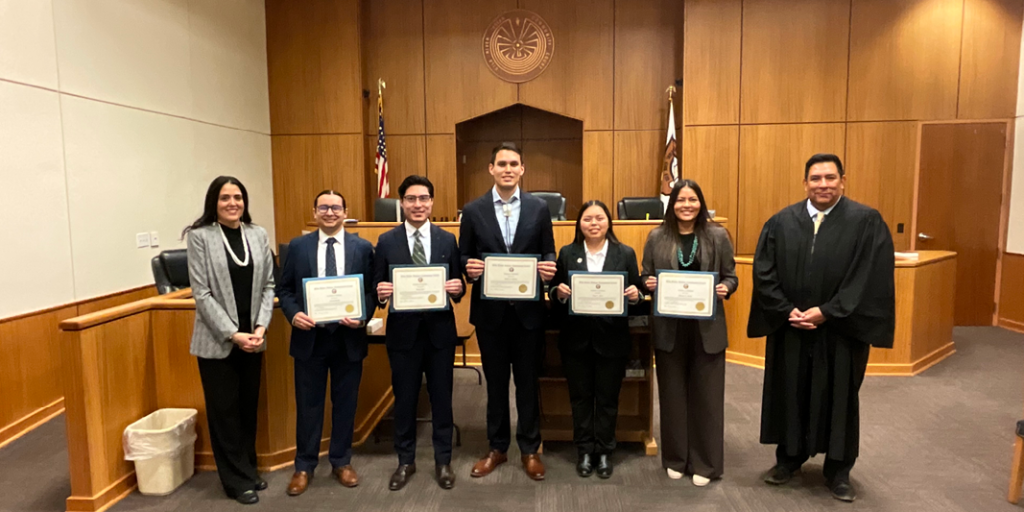
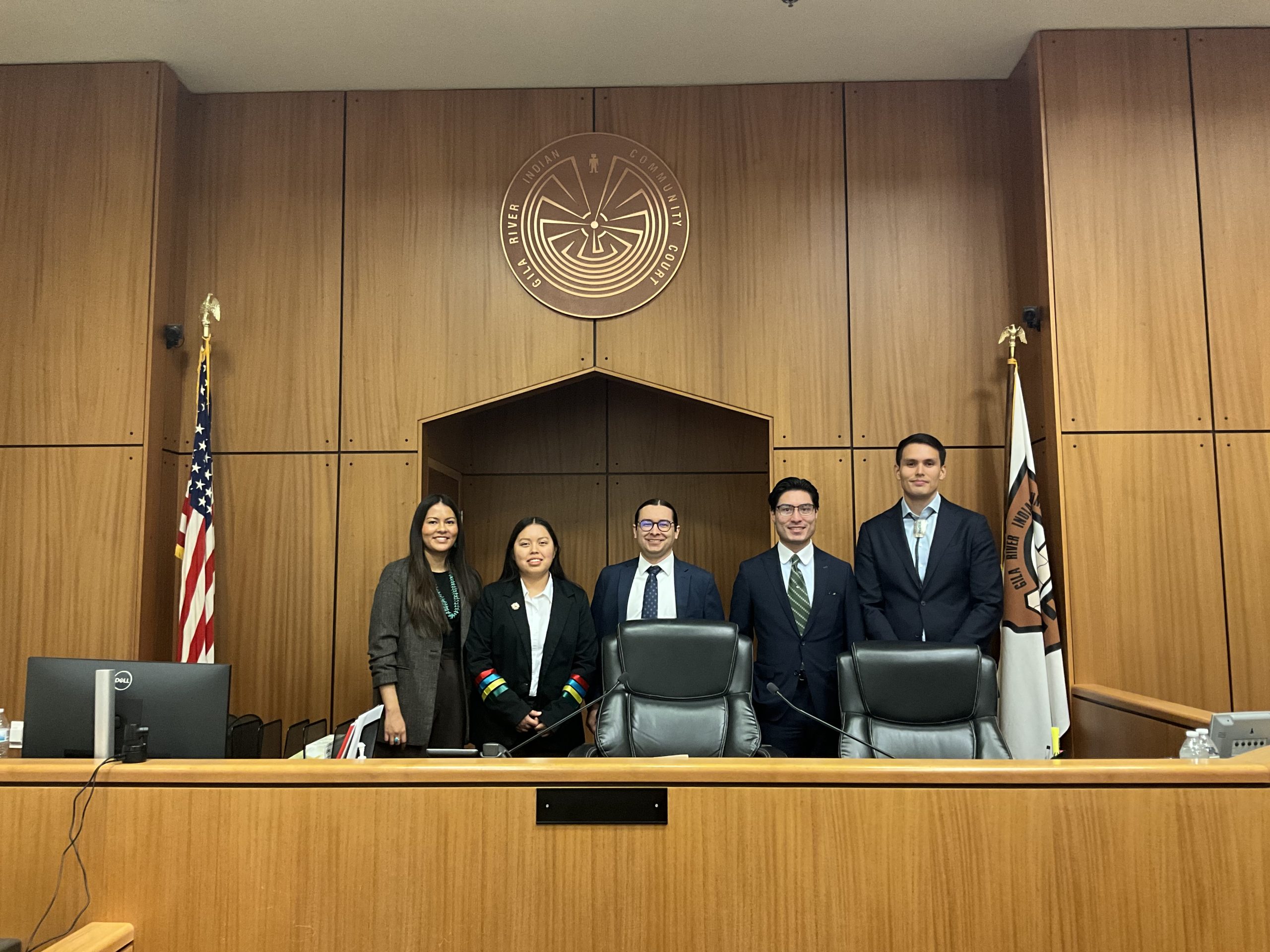
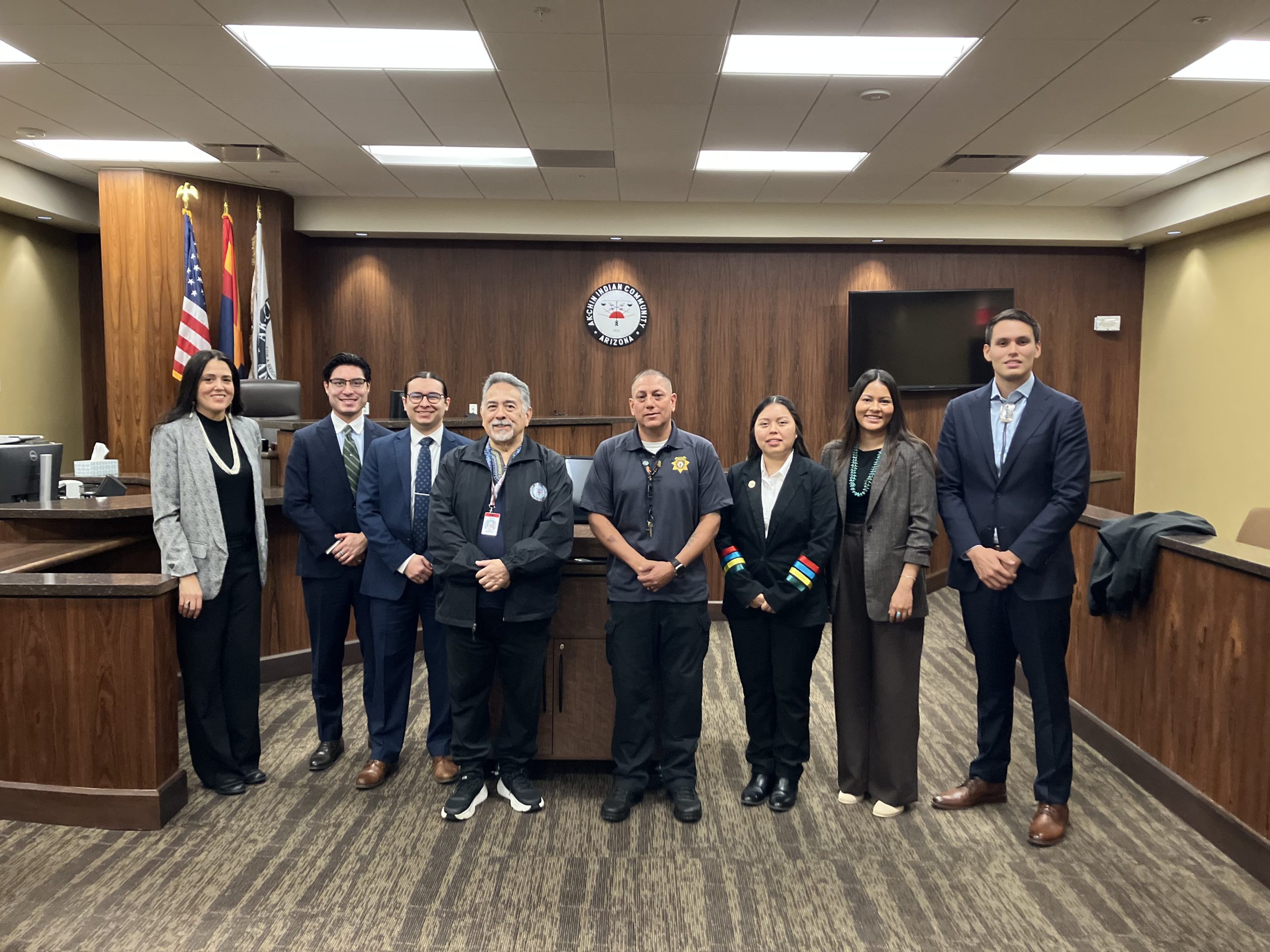
To kick off the spring semester, Professor Patty Ferguson-Bohnee and Indian Legal Clinic students Jerimy Billy, Angel Nosie, Justice Oglesby, Crispin South and Monique Tsosie traveled to the Ak-Chin Indian Community Tribal Court in Maricopa, Arizona, and the Gila River Indian Community Court in Sacaton on Jan. 30. The visit marked the beginning of the students’ hands-on legal training, where they will work directly with real clients through the clinic.
At the Ak-Chin Indian Community Court, students met with Prosecutor Raymond Vaca (’06) and pretrial officer Xavier Rojas, who provided an overview of court proceedings and shared insights from their legal careers.
Students also met with Chairman Gabriel Lopez of the Ak-Chin Indian Community and Ammon Orr (’16) a prosecutor at Gila River. Chairman Lopez spoke about the Tribe’s history, leadership’s role in advancing community interests, the Tribe’s successes and the importance of preparing the next generation to protect its sovereignty and legacy. Orr shared his journey in the legal profession and his work as a prosecutor serving tribes.
At the Gila River Indian Community Court, student attorneys took an important step in their legal careers as they were sworn in by Chief Judge Anthony Hill (’06). Judge Charles Aragon led a tour of the court, introducing students to judges and staff and offering a behind-the-scenes look at the court’s operations.
“I’m excited for the clinic and the opportunity to gain practical experience,” said third-year law student Nosie. “Taking the oath and being sworn in is especially meaningful — it’s something I’ve never been exposed to before. Experiencing it firsthand and beginning to practice like a lawyer makes me excited for the future.”
The Indian Legal Program extends its appreciation to the Ak-Chin Indian Community and the Gila River Indian Community for their continued support and partnership in educating the next generation of Tribal advocates.
2026 ILP Alumni Awards: Call for Nominations
The ILP alumni awards are now open. Nominate your classmates and friends! The ILP Awards include Professional Achievement, Alumni Service Award, and Emerging Leader Award.
Nominations deadline: March 6, 2026
Send nomination and materials to: ilp@asu.edu. Awards will be presented at the ILP Alumni & Friends Awards Ceremony at Fed Bar on Thursday, April 9, 2026 in Scottsdale, Arizona.
Nomination Guidelines
ILP Professional Achievement Award – This award recognizes outstanding achievement in Indian Law or Tribal Law throughout an individual’s career. The award honors ILP alumni whose achievements in the field of Indian Law or Tribal Law have brought distinction to themselves and real benefit to Tribal Nations. Nomination Package requirements:
- Describe the unique professional achievements in the field of Indian Law or Tribal Law that has brought distinction to the candidate. (maximum two pages)
- Describe the recognized contributions made by this candidate that demonstrate a benefit to the larger community. (maximum one page)
- Describe the ways in which the candidate’s achievements are truly extraordinary or exceptional. (maximum one page)
- Provide at least two letters of support from individuals that can speak to the candidate’s impact on his or her profession.
- Letters of support should speak to the magnitude of the individual’s impact in the practice of Indian or tribal law or in the Indian community.
- Provide a 200 word bio of the nominee.
- Past winners include: Claudeen Bates Arthur (’74) (Posthumous), Gloria Kindig (’89), Kathy Bowman (’86), Rob Rosette (’96), Diane Enos (’92), Herb Yazzie (’75) and Ben Hanley (’71).
ILP Alumni Service Award – This award is given for outstanding service to the Indian Legal Program, and is awarded for extended, extraordinary service to the Indian Legal Program. Nomination Package requirements:
- Describe the ways in which the candidate has served or supported the ILP and the ILP alumni. Examples can include serving on committees, boards, CLEs, mentoring ILP students, or other volunteer or fundraising efforts or funding commitments. (maximum one page)
- Describe the ways this service been truly extraordinary. (maximum one page)
- Describe how the candidate’s service has benefited the ILP. (maximum one page)
- Please provide at least two letters of support from ILP alumni as part of the nomination package.
- Provide a 200 word bio of the nominee.
- Past winners include: Chris Love (’05), Brian Garcia (’20), Rebecca Ross (’10), Rodina Cave Parnall (’01), Peter Larson (’02), Verrin Kewenvoyouma (’04), Jeff Harmon (’05), Mary Shirley (’92) and Ann Marie Downes (’94).
ILP Emerging Leader Award – This award acknowledges and encourages service to Indian Country and the ILP by alumni who are less than ten years out of law school. The award recognizes outstanding achievements in their professional career, volunteer work, and promotion or support of the ILP and/or ASU NALSA. Nomination Package requirements:
- Describe how the candidate has achieved professional success in their legal career.
- Describe the candidate’s volunteer work.
- Describe how the candidate achieved an exceptional level of service while balancing the demands of being a recent graduate. (maximum one page)
- Describe how the candidate was proactive in efforts to become involved in ILP and/or ILP alumni activities. (maximum one page)
- Describe how the candidate’s service has been sustained over a long period of time or how the service has been innovative or beneficial. (maximum one page)
- Provide two letters of support from fellow ILP alumni.
- Provide a 200 word bio of the nominee.
- Past winners include: Candace French (’17), Krystalyn Kinsel (’15), Stephanie Sfiridis (’16), Jacob Schellinger (’12), Derrick Beetso (’10), Carolyn Angus-Hornbuckle (’09), Nikki Borchardt Campbell (’09), Michael Corey Hinton (’11), Matthew Campbell (’08), Charles Galbraith (’07), Elizabeth Medicine Crow (’05) and Steve Bodmer (’06).
Job opportunities: Yavapai-Apache Nation Tribal Court
Yavapai-Apache Nation Tribal Court
Chief Judge
Department: Tribal Court
Job Vacancy: YAN-26-20
Starting Wage: DOE
Opening Date: 01-26-26
Closing Date: Until Filled
POSITION DESCRIPTION:.
The Chief Judge presides over and ensures proper operation of the Yavapai-Apache Nation Tribal Court. The Chief Judge is the primary Judicial Officer of the Tribal Court and is the administrator of the Nation’s Tribal Court.
Review full job announcement: Chief Judge
Associate Judge
Job Vacancy: YAN-26-21
Starting Wage: DOE
Opening Date: 01-26-26
Closing Date: Until Filled
POSITION DESCRIPTION:
The Associate Judge presides over cases before the Tribal Court and helps ensure the proper operation of Yavapai-Apache Nation Tribal Court under the supervision of the Chief Judge.
Review full job announcement: Associate Judge
Job opportunity: Director for Native American Program
Director for Native American Program
Santa Ana, New Mexico
New Mexico Legal Aid (NMLA) provides civil legal services to low-income New Mexicans for a variety of legal issues including domestic violence/family law, consumer protection, housing, and benefits. NMLA has locations throughout the state including Albuquerque, Santa Fe, Las Cruces, Gallup, Roswell, Silver City, Las Vegas, Taos, and Santa Ana.
The Native American Program (NAP) of NMLA provides free legal services to low-income Native Americans living on or near the 19 Pueblos and outreach services to the Mescalero Apache community in New Mexico. The majority of NAP’s civil and criminal misdemeanor cases are in Pueblo Courts.
The NAP Director is responsible for administration and management of the overall operations of NAP, including:
- Ensuring that the civil legal needs of its client community are met, including initiating and completing period needs assessments.
- Partnering and collaborating with tribal entities within the service area.
- Developing projects and programs to leverage NAP resources, including funding opportunities.
- Integrating NAP’s technology and communications needs into NMLA’s statewide system.
- Overseeing the NAP’s legal advocacy, including supervising the Litigation Specialist.
- Organizing and participating in community education and outreach activities to the various Pueblo communities.
- Working in close collaboration with other members of NMLA’s management team; and
- Being active in local bar associations and community activities.
The Native American Program handles creative, challenging, and complex work. We are looking for highly motivated candidates who are passionate and strongly committed to helping NMLA better serve our client communities, including developing effective team strategies to handle complex advocacy and extended representation cases.
The position is based in Santa Ana Pueblo, New Mexico but requires statewide travel.
Requirements:
- License to practice law in New Mexico or become licensed within six months of employment.
- Indian and Tribal law experience working in tribal communities, preferably Pueblo communities.
- At least five (5) years of experience as an attorney, some of which should include practice in tribal courts.
- Prior experience in administrative and supervisory roles is preferred.
- Experience in supervising legal advocacy in Federal, State and/or Tribal Court.
- Cultural knowledge and sensitivity to work with sovereign nations, including tribal courts and tribal governments and agencies.
- Sensitivity to and ability to work with diverse low-income populations.
- Excellent communication, writing and analytical skills.
- Self-motivated individuals with strong interpersonal and managerial skills.
- Be willing to travel.
- Ability to manage multiple tasks and build collaborative relationships within the NMLA staff and the legal services community.
- Proficiency in Keres or other relevant Native American language is a plus.
Applicant’s life experience, as well as academic and professional experience, will be considered.
Company Benefits:
- 100% employer-paid BCBS medical, plus dental and vision for employees; generous contributions for dependents
- 3 weeks vacation time, 6 days personal time, liberal sick pay, and federal holidays off
- Comp time for overtime
- Hybrid work schedule (3 days in office, 2 days remote – your choice!)
- 37.5-hour work week
- 403(b) Retirement Plan
- Competitive salary
- Click herefor more information
Salary: depending on experience.
Deadline to apply: January 10, 2026
Applicants must submit a current resume, three references, and a cover letter that explains your interest in this position and the mission of NMLA. Your application will not be considered unless we receive both of these documents. To apply, visit: https://newmexicolegalaid.isolvedhire.com/jobs/1665294
Applicants will be subject to a background search. Please do not let this deter you from applying. NMLA is committed to a strong workforce and recognizes that persons with marks on their record may still be able to perform admirably.
Job Opportunity: Native American and Tribal Affairs Attorney
Job Description and Duties
The Native American and Tribal Affairs Section (NATA) advises and represents the Governor and the State on Native American and tribal issues, including tribal-state gaming compact negotiations, civil and criminal jurisdiction on tribal lands, cultural resource protection, government-to-government consultation, litigation, and other matters involving legal relationships between Native American organizations and the State.
NATA is housed in the Division of Public Rights (PRD). The Public Rights Division serves Californians by safeguarding the State’s environment and natural resources, protecting state lands, maintaining competitive markets, preventing fraudulent business practices, protecting consumers against misleading advertising claims, preserving charitable assets and protecting civil rights. NATA collaborates with other sections in the PRD along with the Office of Native American Affairs to provide legal expertise across diverse legal topics and tasks. NATA Deputies litigate complex legal matters, negotiate and draft government to government agreements with tribes, ensure compliance with state and federal laws pertaining to gambling, and provide support and insight on policy matters as requested.
See full job posting and apply at: https://calcareers.ca.gov/CalHrPublic/Jobs/JobPosting.aspx?JobControlId=498199
Election procedures manual Tribal leader listening session
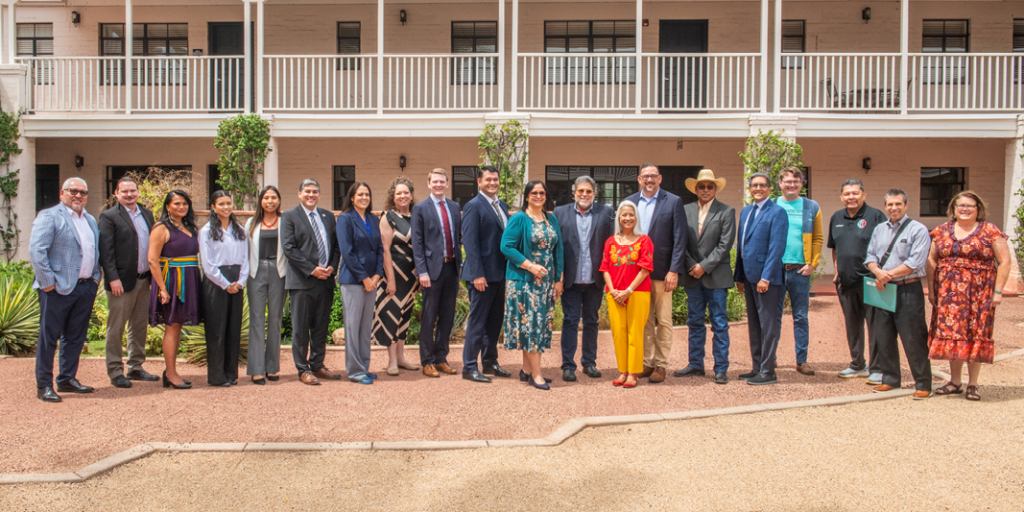
On Aug. 28, Patty Ferguson-Bohnee, Indian Legal Clinic director and associate dean for Inclusive Excellence, and Maya Araujo, Native Vote Management Intern, attended a Tribal Leader Listening Session on the Arizona Election Procedures Manual (EPM). Arizona Secretary of State Adrian Fontes in partnership with the Inter Tribal Council of Arizona held the session to gather feedback specifically from Tribal leaders on the draft of the 2025 EPM. Arizona law requires the Secretary of State to draft an EPM that brings “the maximum degree of correctness, impartiality, uniformity and efficiency” to elections. The EPM must be updated on odd-numbered years and submitted to the Attorney General and Governor for their approval.
At the Tribal Leader Listening Session, Fontes and Lisa Marra, State Election director from the Office of the Arizona Secretary of State, provided an overview of the EPM. Ferguson-Bohnee presented on the Tribal provisions and relevant topics from the EPM that impact Tribal voting rights. The ILC engages in the EPM comment process closely as, once approved, the EPM has the force of law and is a binding document that ensures the election process is consistent, efficient and legally sound for every voter.
Review the full 2025 Elections Procedures Manual.
Applying federal Indian law in accounting practice: Joseph Bryant (MLS ’25)
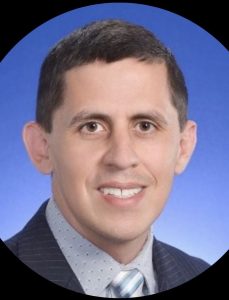
Born and raised in rural Indiana, Joseph Bryant left home to serve in the U.S. Air Force, an experience that broadened his worldview and set the foundation for his professional journey. Now based in San Diego, with previous ties to Las Vegas, he has built a career as a certified public accountant with more than 14 years of experience in public accounting. At Delsen and Company LLP, he works with high-net-worth individuals and their related entities, such as businesses and trusts. Looking ahead, he hopes to become a partner and expand the firm’s practice into new areas, including supporting Native American-owned businesses.
He recently reflected on his MLS experience and career path in this Q&A.
What inspired you to pursue the MLS program, and did you have a particular emphasis?
I did not grow up in Native American culture, so I have felt robbed of that part of my heritage. My grandmother was born on a reservation, but she married and moved away in her early 20s. I wanted to learn more about my tribe’s history (Red Lake Band of Chippewa Indians) and about the legal history that Native Americans have with Federal, state, and local governments. I want to help bridge the gap between Native Americans and other peoples. My ancestor Peter Graves led Red Lake for many years and retired from the Federal government after 30 years of service. He successfully bridged the gap between Red Lake and the Federal government, and I want to continue that legacy. I hope to bring unique power to the Native American community by combining newly-acquired knowledge from the MLS program with my accounting skills.
My emphasis areas in the MLS program were Federal Indian Law, Indian Gaming, Tribal Self-Governance and Sustainability. Once I began learning, I did not want to stop!
Can you share a specific moment during the MLS program when you saw the direct relevance of what you were learning to Tribal governance or your work?
Internal control standards and audit requirements were some of the topics covered in Indian Gaming II. These might bore many students, but my CPA mind was dialed into that content. Some of the court cases and official complaints covered activity by tribes and their members that violated auditing and internal control standards. This helped balance my view of Native Americans and their relationship with the Federal government. Yes, Natives have suffered many wrongs at the hands of non-Natives, but external oversight is needed in some areas to help protect Native citizens from being harmed by their own people. Tribal self-governance should be encouraged and is good for Natives, but we need to lean on the Federal trust relationship during key times of tribal evolution.
How has your MLS degree helped you in your work? Or what is one project, case, or initiative you’ve been involved in since graduating that you’re most proud of? How did your MLS training help prepare you for it?
My public accounting firm has a client that is starting a sports leadership academy for disadvantaged communities, and I want to put Native Americans into that conversation. The academy is not up and running, but I am eager to start the process. This could be an exciting opportunity for Natives, as the leadership academy is connected to a professional sports team. I might not have had the idea to bridge that gap if I had not earned my MLS degree because of my networking and by making Indian affairs part of my daily consciousness. I can also speak confidently about Native American topics with outsiders because of my coursework.
What challenges did you face as an MLS student, especially balancing work, life, and community responsibilities—and how did you overcome them?
I work long hours during tax season and extension season in the fall (60+ hours a week), so time management was crucial. I would plan out my week in general the first day that a module opened (i.e., I would check Canvas for each class and get an idea of what I needed to do for that week and think about how to break it into manageable pieces). I used the Sticky Note feature in Windows to copy and paste the homework requirements and mark off items that I completed, listing due dates as needed.
I found that doing homework during my lunch hour was key, because I was able to get a head start while my energy level was still high. Watching a few videos or reading a few PDFs gave me a boost because I knew that I was doing things that I would not have to do later.
I would do two more hours of homework every night after work, and I used Saturday mornings/afternoons for quizzes and tests because I was not drained from a full day of work. Sundays were either getting a head start on the week (if modules began on Thursdays) or by wrapping up homework for the week (if modules began on Mondays). I viewed myself as a homework machine – be consistent, be steady, pat myself on the back when I would get key items done, and keep on going.
I have a family, so I had to carve out time for them during the MLS program. I tried doing fun activities like live sporting events and going to movies, which worked well because I was away from the house and away from responsibilities with fun distractions. I think that you have to make it clear to those around you that the degree program is a primary focus that you are going to have for some time, and that your life has to change for a while. If there are children in your life, showing them that studying matters is an example they will remember.
What advice would you give to others considering the MLS program?
If someone feels led to pursue the MLS degree, they should do it. I think that it gave me vital legal knowledge without the need to attend law school. I considered law school when I was younger, but I chose accounting instead. The MLS program is perfect for working professionals who are deep into their careers but want to add legal knowledge and skills via the emphasis areas of their choice. I networked with other students and faculty that I would not have met otherwise. I did not grow up around other Native Americans, so making new Native friends was very rewarding for me.
Is there a faculty member, class, or experience in the program that left a lasting impression on you? Why?
Professor Hoenig taught Indian Gaming I and II. He took complex material and separated it into interesting and manageable chunks of information. He was very approachable, offering an optional Zoom meeting during Indian Gaming II to get to know the students better. I really appreciated his deep understanding of the material and the chance to chat with him during the Zoom meeting. Professor Spruhan also offered an optional Zoom meeting during Civil Jurisdiction in Indian Country.
It is easy for online students like myself to feel isolated or that they are not full-fledged students. Zoom meetings add life and color to the online experience. I left the meetings putting faces to the names and I knew that they had done the same for the students who attended.
What’s one small change or initiative that you believe could make a big difference for tribal communities?
There are many disadvantaged communities in the United States, but Natives are very few and are often overlooked. I think that Native Americans should examine existing initiatives from third parties and find ways to connect their communities with those programs. This would be more effective than trying to start programs from scratch, as Federal assistance has been chronically underfunded and many tribes struggle to generate internal funding. The private sector has many donors looking to make a difference, and Natives need to network effectively with those who are interested in assisting minorities.
Where are they now? Feat. Carolyn Clark Loder (MLS ’11)
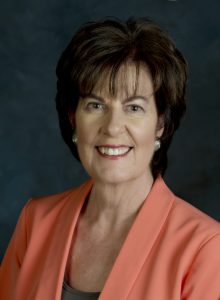
Carolyn Clark Loder is a seasoned leader in the mining and natural resources industry, serving on the boards of directors of K2 Gold Corporation and Integra Resources, where she also chairs its Environment, Social, Governance Committee. As a board consultant and expert witness in mineral rights and Tribal engagement, she advocates for Indigenous inclusion at the highest levels of corporate decision-making.


Earning her Master of Legal Studies in Indian Law from ASU Law in 2011 was a transformative experience that broadened her perspective and deepened her commitment to equity and education. The first woman inducted into the National Mining Hall of Fame in 2023, Carolyn continues to champion change in an industry historically led by white men — ensuring that all stakeholders, especially First Nations, have a seat at the table.
Q: What has your journey been like since graduating?
A: Upon getting my MLS in Indian Law, it opened up a broader view of the world that has enabled me to influence corporate America with that vision. As a non-Indian, I admit I knew nothing of our colonial past as I was indoctrinated into learning only the history of MANkind. As a young girl I could find no women heroines in history – they were all men. And all white men. And, I knew nothing of our First Nations.
Being inducted into the National Mining Hall of Fame as the first living woman — and the first woman in 100 years — is not only amazing to me, but more a reflection of our past in that it has always been white men and corporate leaders who were recognized. I have seen a change in perspective over the last 40 years that wealth seeking is not the end all. All stakeholders are important in projects, not just the shareholders. I am fortunate to serve on publicly traded boards that recognize this shirt and support my belief that our First Nations have a voice and can bring positive change to the table.
I also was able to help influence a decision that brought a Tribal member onto a publicly traded Board. That is the next step – to have Tribal members on publicly traded Boards so that their advice and opinions are incorporated into decision making. Having them as employees is not the same — it does not effectuate change at the top.
Q: What is the most valuable lesson you learned in the classroom that has helped you in your career?
A: The lesson I learned in the classroom is that Indian Law is complicated — very complicated — and despite my degree, I still know very little. The general public knows even less. I always have stories to tell folks and I am pleasantly surprised at how much interest people have and the questions they ask about Indian law. I wish the basics of Indian Law were taught in elementary school, particularly in the western states. It should be mandatory in high school civic classes.
Q: Is there anything you’ve learned after graduating that you wish you had learned in class?
A: I miss the CLE classes that were always on current topics. They were so informative and I felt like I was still in the mainstream of learning. Without those classes, I lost touch with the Indian Law program, other than continued contact with a few students.
I also wish I had learned about the Tribes in Arizona. Having lived here for 30 years and being born in California, I still know so little of the Tribes of my homeland.
Q: What originally made you choose ASU Law?
A: Clearly, it was the Indian Law program and the staff and professors and Heidi McNeil Staudenmaier of Snell Wilmer. She and I worked together on a landmark Tribal land exchange in New Mexico that returned 20,000 acres of ancestral lands to two Tribes. She told me about a fairly new degree at ASU called an MLS. She suggested I speak to Associate Dean Gary Birnbaum to see if I could focus my course work entirely on Indian Law. I had completed my first-year law courses elsewhere years earlier, so those credits were already in place. Upon acceptance, I truly felt welcomed, particularly being the ‘older’ one in the classrooms. And the students were phenomenal. They welcomed me, and I made sure I always found time for them to share their concerns. Being older, I was a safe haven for them to discuss their fears, their problems and their hopes and dreams. I had not anticipated that my advice would even be sought after — I truly thought they would be disinterested. But, it was the opposite.
Q: What advice would you give to current students?
A: I would say that they are truly blessed being in the Indian Law program at ASU, especially because it focuses on Indian Law versus Indigenous Law. There is so much to learn in the U.S. that I feel that if I took the global approach, I would not have learned as much as I did -– which is still very little. Focusing on the U.S. has given me the advantage to apply that knowledge to specific projects, situations and decisions.
Q: What’s something you’d like people to know about you? (This can be a fun fact or anything else you’d like to share!)
A: I was married years ago in Antarctica to a Canadian on lands claimed by Argentina and not recognized by the U.S., by a Russian Ice Breaker Captain. My husband was born in Labrador, before it joined Canada as part of the province of Newfoundland and Labrador. He was born in the northern community of Hopedale, which is now a National Historic Site and legislative capital of the autonomous Inuit region of Nunatsiavut. His father ran the trading post and his mother cared for the Indigenous Peoples of Labrador with only a nursing degree and a dog sled. She received the Order of Canada by Her Majesty Queen Elizabeth II, recognizing her dedication to the Native community and service to the Nation. Good footsteps for me to follow.
Q: Is there anything else you’d like to add?
A: I have had a very blessed life in that I grew up in a rural area with no knowledge of the world and at age 18, I sailed around the world with World Campus Afloat. That exposure changed my life forever. I became a sponge for knowledge and with supportive parents, family, friends and community I was able to pursue my hopes and dreams. I wish everyone had such a support group.